ASE A3 Manual Drive Train & Axles — Free Course & Practice Test
The complete ASE A3 course, free on YouTube: 64 video lessons built from ASE's published
A3 task list, with a printable workbook for every module. The ASE A3 exam itself is 50 questions (40 scored + 10 unscored) in 60 minutes.
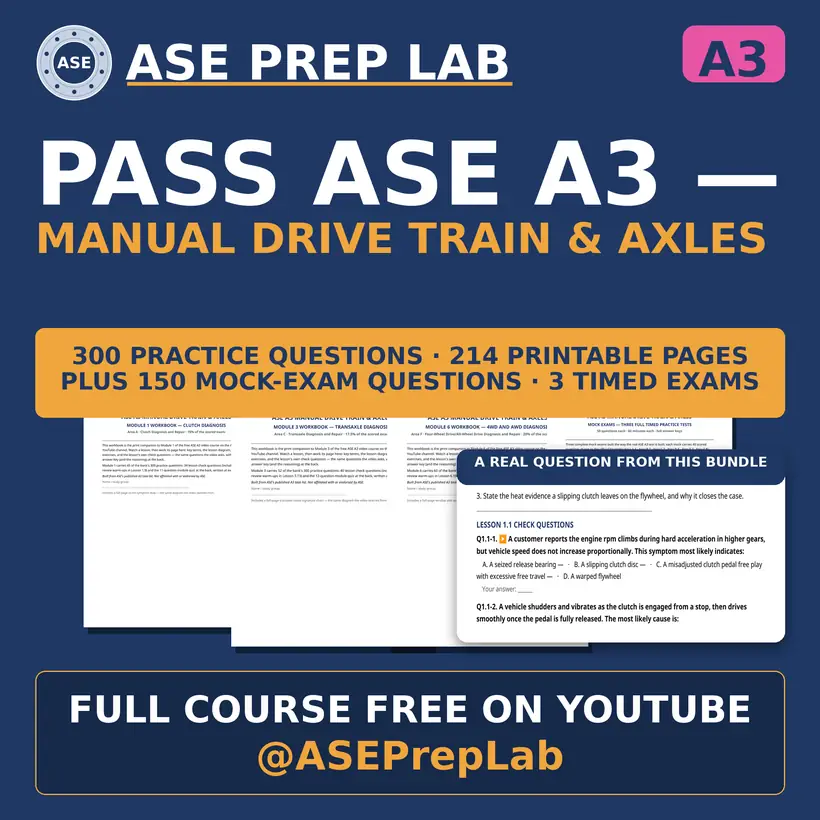
Prefer to study on paper? Each module has a printable follow-along workbook with worksheets and practice questions
drawn from the same 300-question bank as the video course.
Seven questions from the ASE A3 question bank, spread across the modules. Pick your answer, then open the reveal
to check it and read the explanation.
Sample question 1 (QA-1, Module 1)
A customer reports the engine rpm climbs during hard acceleration in higher gears, but vehicle speed does not increase proportionally. This symptom most likely indicates:
A seized release bearing
A slipping clutch disc
A misadjusted clutch pedal free play with excessive free travel
A warped flywheel
Show answer
Answer: B. Rpm rising without matching road speed under load is the classic signature of clutch slippage — the disc can no longer hold engine torque, so the engine flares while the driveline does not accelerate. Distractors: A produces noise and release problems, not slip under load. C causes incomplete release and hard shifting, the opposite failure. D causes chatter and pulsation on engagement rather than steady-state slip. Source: Task A1.
Sample question 2 (QA-2, Module 1)
A vehicle shudders and vibrates as the clutch is engaged from a stop, then drives smoothly once the pedal is fully released. The most likely cause is:
A worn pilot bushing
Low hydraulic fluid in the clutch master cylinder
A bent transmission input shaft
Oil or grease contamination on the clutch disc facings
Show answer
Answer: D. Contaminated facings grab and release unevenly during engagement, producing chatter; once fully clamped, the slip-stick behavior stops and the vehicle drives smoothly. Distractors: A typically causes noise and shifting problems with the clutch disengaged. B causes release problems, not engagement shudder. C is rare and would not limit the symptom to the engagement event. Source: Task A1.
Sample question 3 (QB-10, Module 2)
During diagnosis of a noise complaint, the noise is present in all gears EXCEPT fourth (1:1 direct drive), where it disappears. This pattern most strongly suggests:
Input shaft bearing failure
Output shaft bearing failure
Countershaft (cluster) gear or its bearings, because in direct drive the countershaft is unloaded and the power flows straight through the mainshaft
A synchronizer failure
Show answer
Answer: C. In direct drive the countershaft carries no load, so countershaft and cluster-gear faults quiet down in that gear alone — a classic isolation test result. Distractors: A and B carry load in every gear including direct. D causes shift clash, not an all-but-one-gear noise. Source: Task B1.
Sample question 4 (QC-1, Module 3)
A FWD transaxle whines in all gears, rising with road speed, and the pitch does not change between gears at the same road speed. The pattern most suggests:
One gear pair in the transaxle
The clutch release bearing
A wheel bearing
The final drive (differential) gear set, which always turns at road speed regardless of the gear selected
Show answer
Answer: D. The final drive's speed is road speed in every gear; a whine tied to road speed and independent of gear selection localizes to the final drive mesh. Distractors: A changes pitch with gear selection. B follows clutch pedal position. C is also road-speed dependent and is separated by steering-load tests and by checking whether the noise changes with drivetrain load versus wheel load. Source: Task C1.
Sample question 5 (QD-2, Module 4)
A FWD vehicle clicks loudly when accelerating through a turn, and the noise stops when driving straight. This is the classic symptom of:
A worn outer (fixed) CV joint — it articulates at steering angle and its worn races/balls click under load in turns
A worn inner (plunging) CV joint
A worn wheel bearing
A failed transaxle mount
Show answer
Answer: A. The outer joint works at the steering angle; worn ball tracks click rhythmically under load in turns and quiet straight ahead. Distractors: B typically shudders on straight-line acceleration. C growls with speed and changes with lateral load, but does not click in turns. D thumps on load changes. Source: Task D1.
Sample question 6 (QE-1, Module 5)
A RWD vehicle has a whine from the rear that is loudest on light throttle cruise and changes pitch when the throttle is lifted. This load-sensitive whine most likely comes from:
The wheel bearings
The driveshaft balance
The muffler
The ring and pinion gear mesh — gear tooth mesh noise is load- and direction-sensitive in a way bearing noise is not
Show answer
Answer: D. Ring and pinion whine follows the mesh: it appears under drive load, shifts on coast, and tracks road speed. Distractors: A makes a steadier growl mostly load-insensitive to throttle. B vibrates rather than whines. C is exhaust, rpm-based. Source: Task E1.
Sample question 7 (QF-1, Module 6)
A 4WD vehicle binds and hops (crow-hop) when making tight turns on dry pavement in 4WD. The tires are matched in size. This behavior on a part-time 4WD system is:
Driveline wind-up — with no center differential, the front and rear axles must turn at the same speed, and in a turn they need to travel different distances, so the driveline winds up until a tire slips — part-time 4WD is not for dry pavement
A failed clutch
A bad alternator
Normal for any drivetrain including AWD street cars in all conditions
Show answer
Answer: A. Wind-up is the physics of a locked front-to-rear connection in a turn; on high-traction surfaces the stress builds until something slips — which is why part-time systems are for loose surfaces. Distractors: B and C are unrelated systems. D — full-time/AWD systems have a center differential or coupler precisely to avoid this. Source: Task F1.
All 300 questions for ASE A3 — with full answer keys — are in the printable workbooks above, and every one is
worked through in the free video lessons.
ASE A3 Manual Drive Train & AxlesComplete bundle $49.99Buy on Etsy
 ASE Prep Lab