The complete ASE A1 course, free on YouTube: 41 video lessons built from ASE's published
A1 task list, with a printable workbook for every module. The ASE A1 exam itself is 55 questions (45 scored + 10 unscored) in 75 minutes.
Every A1 module workbook — follow-along worksheets matched to the free video lessons
The complete 300-question bank with full answer explanations
Three printable mock exams with full answer keys
One-time purchase · Digital files for personal study
Look inside the workbook
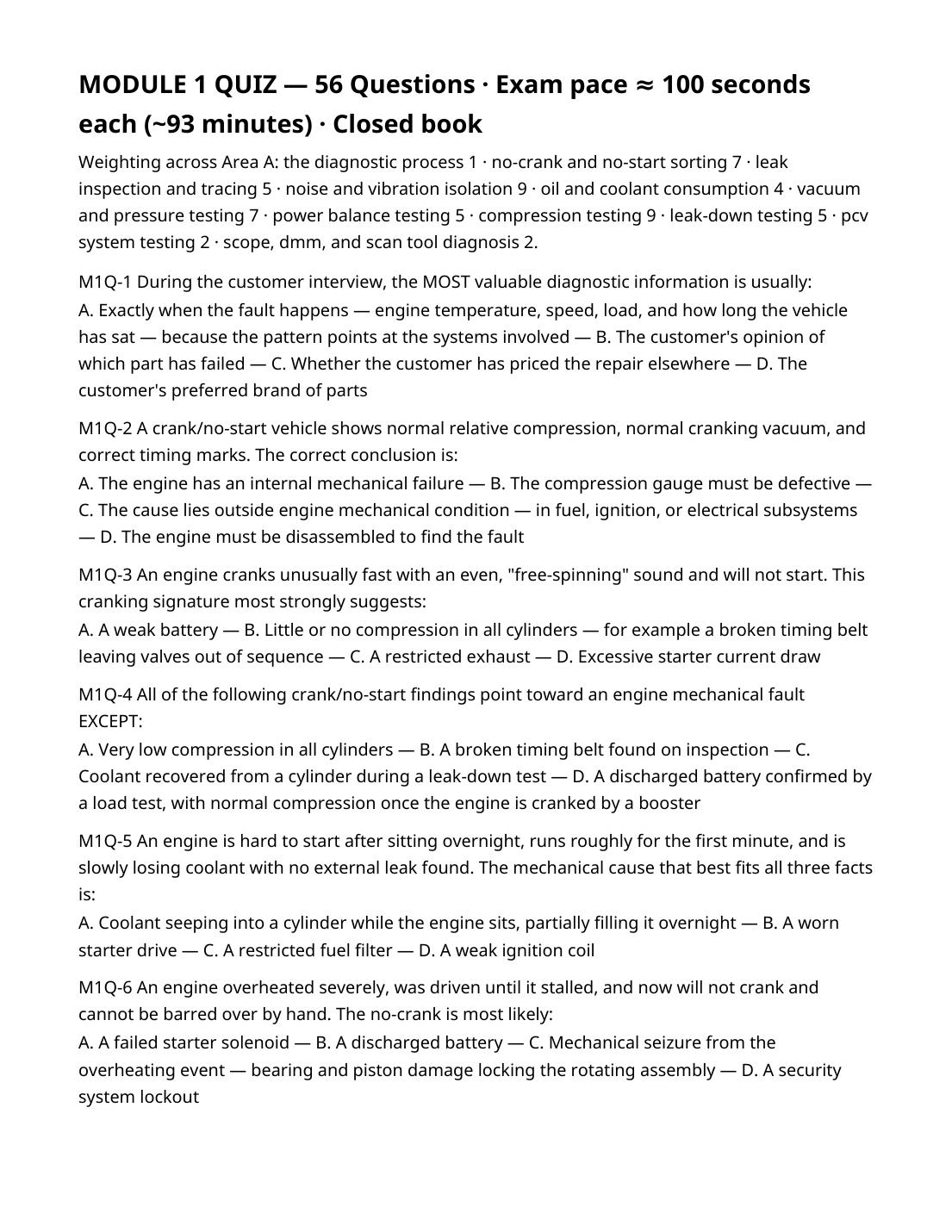
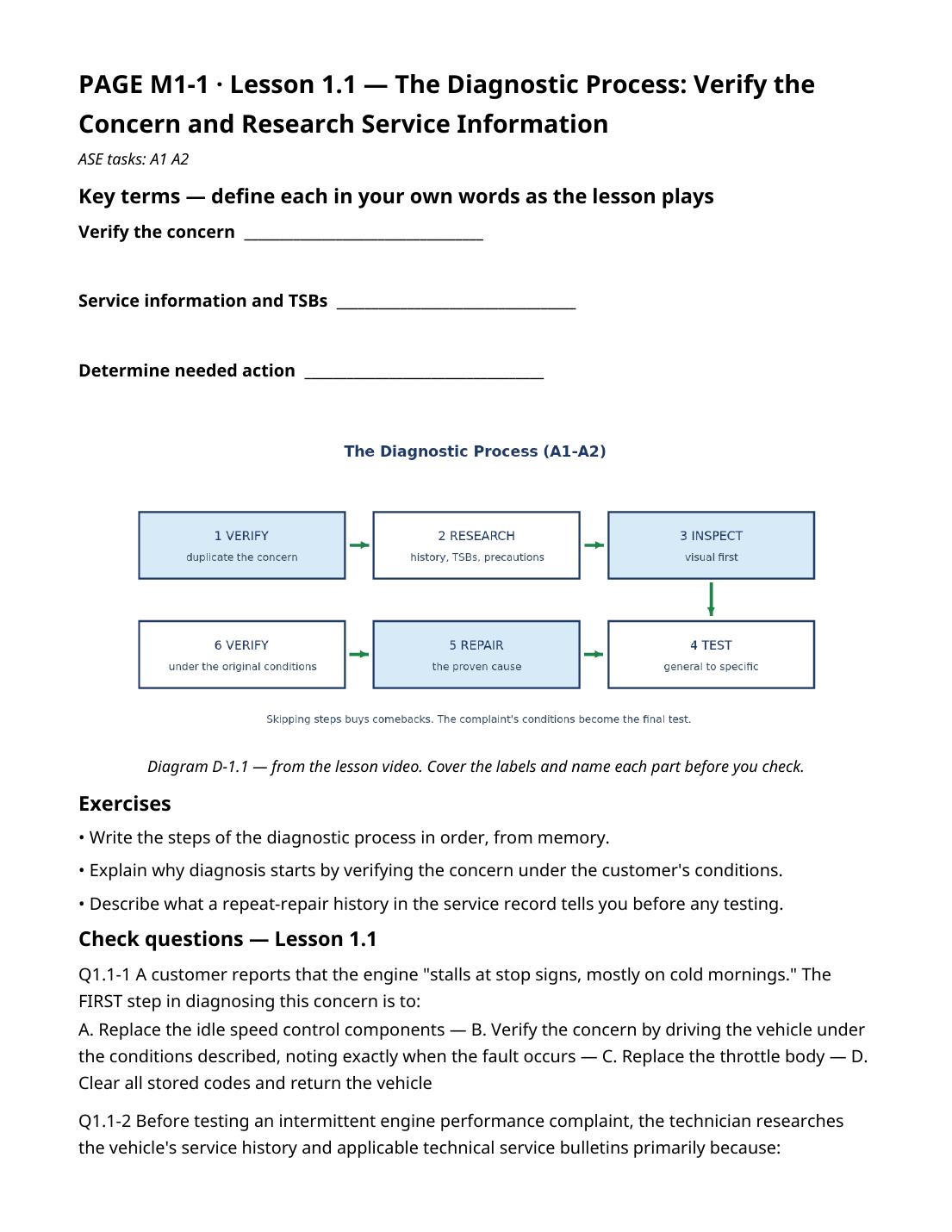
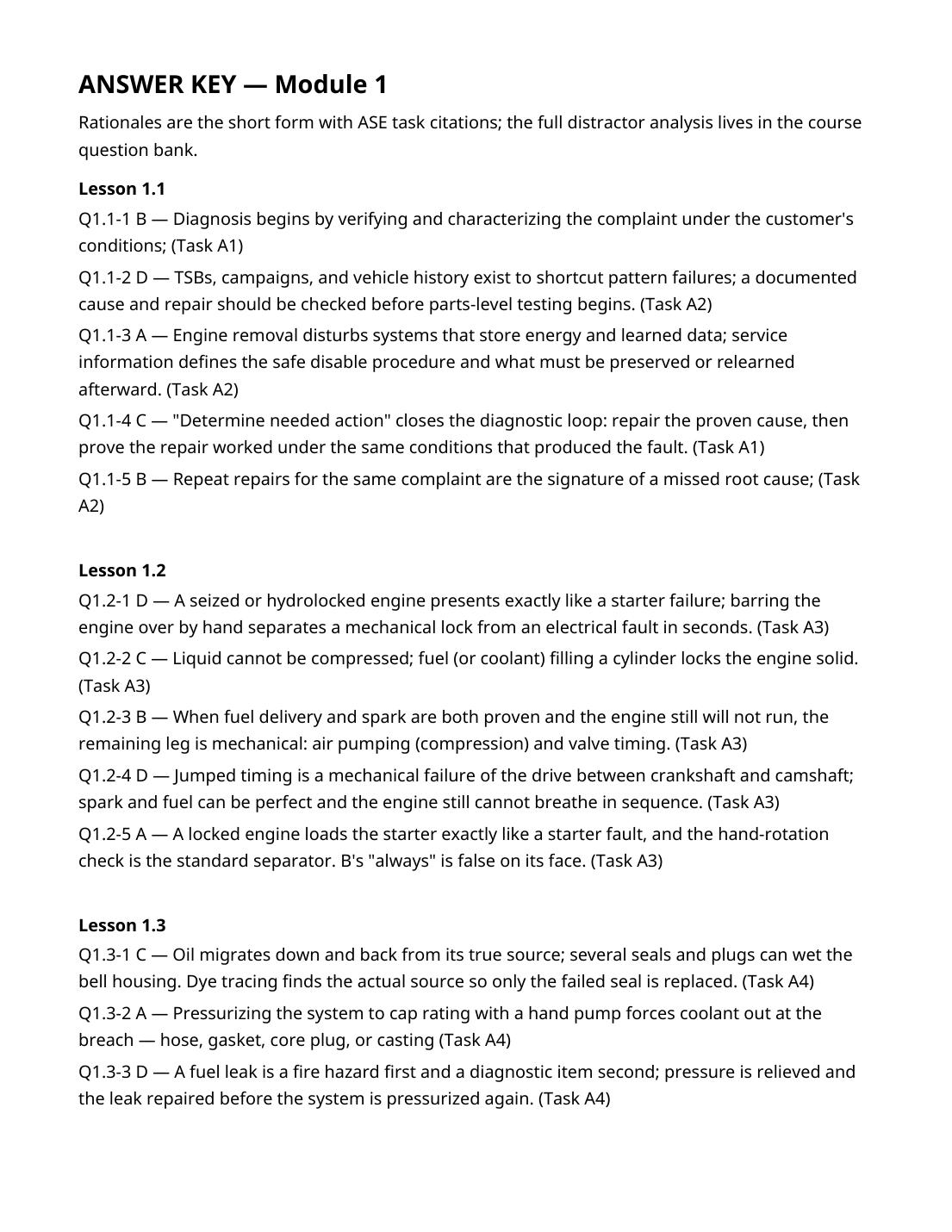
Actual pages from the ASE A1 Engine Repair Module 1 workbook — the same PDF you download after checkout. Every module follows this format: a follow-along worksheet for each lesson, lesson check questions, a timed module quiz, and a complete answer key with rationales.
Timed module quiz — Module 1 workbook, PDF page 28Follow-along worksheet — Lesson 1.1, Module 1 workbook, PDF page 2Answer key with rationales — Module 1 workbook, PDF page 37
Printable workbooks
Prefer to study on paper? Each module has a printable follow-along workbook with worksheets and practice questions
drawn from the same 300-question bank as the video course.
Buying one topic at a time? Each module below includes only that module\'s workbook and its questions. The complete pack above includes every module plus the Finals mock exams.
Seven questions from the ASE A1 question bank, spread across the modules. Pick your answer, then open the reveal
to check it and read the explanation.
Sample question 1 (QA-31, Module 1)
An engine leaks oil from the valve cover one week after the valve cover gasket was replaced. The most likely cause is:
Excessive crankcase pressure
A defective new gasket in every case
Worn piston rings
Installation error — a pinched or displaced gasket, uneven torque, or an uncleaned sealing surface during the recent repair
Show answer
Answer: D. A leak that begins immediately after a repair points first at the repair itself: gasket seating, torque sequence, and surface preparation. Distractors: A and C are engine-condition causes that would have leaked before the gasket job too. B blames the part without inspecting the installation. Source: Task A4.
Sample question 2 (QA-91, Module 1)
A cylinder shows normal cranking compression but low running compression, and its running reading responds weakly to a snap of the throttle. This combination most likely indicates:
A valve train fault — such as a worn camshaft lobe or collapsed lifter — that limits valve lift at running speed while static sealing remains good
Worn piston rings
A head gasket leak
Low fuel pressure
Show answer
Answer: A. Running compression measures breathing, not just sealing: a valve that seals at cranking but barely opens at speed starves the cylinder dynamically. Worn lobes are the classic find. Distractors: B would lower the cranking reading too. C would show in cranking and leak-down results. D is not visible in a compression gauge at all. Source: Task A9.
Sample question 3 (QB-10, Module 2)
Valve spring installed height is measured:
With the spring removed, at free length
By counting the spring's coils
From the spring seat on the head to the underside of the retainer, with the valve and retainer installed; shims under the spring correct height (and therefore seat pressure) to the manufacturer's specification
From the valve tip to the rocker arm
Show answer
Answer: C. Installed height is a dimension of the assembled valve train, and it sets closed-spring pressure: too tall is weak, too short over-stresses. Shims restore it after seat and valve machining sink the valve. Distractors: A measures free length, a different check. B counts a design feature. D measures a lash-related gap, not spring height. Source: Task B4.
Sample question 4 (QB-30, Module 2)
After an overhead cam head is resurfaced, the camshaft binds when its caps are torqued, though the journals measure in specification. The likely cause is:
Incorrect valve lash
Camshaft bore (caps and pedestal) misalignment — the overheated head warped along the cam tunnel, so straight journals sit in a bent bore
Weak valve springs
Excessive end play
Show answer
Answer: B. A bent cam tunnel binds a straight cam; the free-rotation check with caps torqued — and bore alignment measurement — is the inspection that catches it, and line boring or head replacement is the correction. Distractors: A, C, and D are valve-train dimensions that cannot bind a cam in its bores. Source: Task B13.
Sample question 5 (QC-14, Module 3)
A main bearing insert shows heavy wear at both edges of its face with a polished center band (an hourglass pattern). This wear pattern most likely indicates:
Normal long service
A journal or bore geometry problem — such as a tapered journal or misaligned main bore — concentrating load at the insert's edges
Dirty oil
Excessive oil pressure
Show answer
Answer: B. Bearings are witnesses: where the insert wears is where the load was. Edge loading points at geometry — journal taper or bore misalignment — and correcting only the insert leaves the cause in the block. Distractors: A — normal wear is even and gradual. C embeds in the center of the bearing face, a different pattern. D does not selectively load edges. Source: Task C9.
Sample question 6 (QD-27, Module 4)
A radiator pressure cap that cannot hold its rated pressure causes:
A lowered system boiling point — coolant boils and is expelled at temperatures the engine should tolerate, producing overheating and coolant loss with no component leak
Higher coolant pressure
Improved cooling
A stuck thermostat
Show answer
Answer: A. Pressure is half the cooling system's antifreeze: each pound of cap pressure raises the boiling point, so a weak cap converts normal operating temperature into boil-over. Caps are tested on a cap tester against their rating, not judged by appearance. Distractors: B and C reverse the failure. D names an unrelated component. Source: Task D7.
Sample question 7 (QE-31, Module 5)
An engine will not run, fuel and spark are both absent, and the PCM's 5-volt reference measures 0 volts with a shorted sensor connected. The correct diagnosis direction is:
Replace the PCM immediately
Replace the fuel pump
Replace the coils
Isolate the shorted sensor or harness branch by disconnecting sensors on the reference circuit one at a time — a single shorted component can pull the shared reference down and disable the whole engine management system
Show answer
Answer: D. Shared-reference circuits fail together and recover together: the reference returns when the short leaves the circuit, naming the culprit without a single module being replaced. Distractors: A condemns the victim of the short. B and C are downstream devices of a dead reference. Source: Task E5.
All 300 questions for ASE A1 — with full answer keys — are in the printable workbooks above, and every one is
worked through in the free video lessons.
 ASE Prep Lab