The complete ASE A7 course, free on YouTube: 47 video lessons built from ASE's published
A7 task list, with a printable workbook for every module. The ASE A7 exam itself is 60 questions (50 scored + 10 unscored) in 75 minutes.
Every A7 module workbook — follow-along worksheets matched to the free video lessons
The complete 300-question bank with full answer explanations
Three printable mock exams with full answer keys
One-time purchase · Digital files for personal study
Look inside the workbook
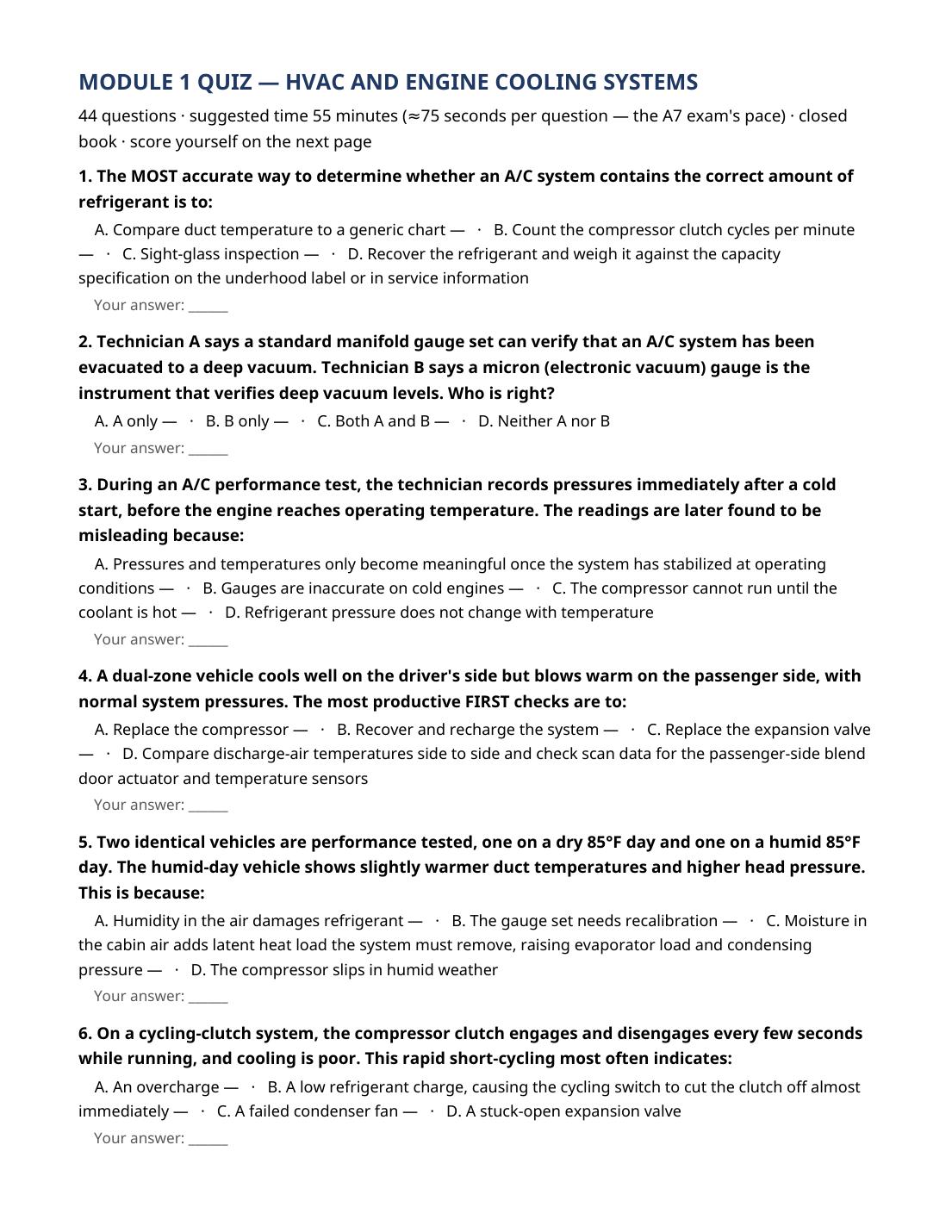
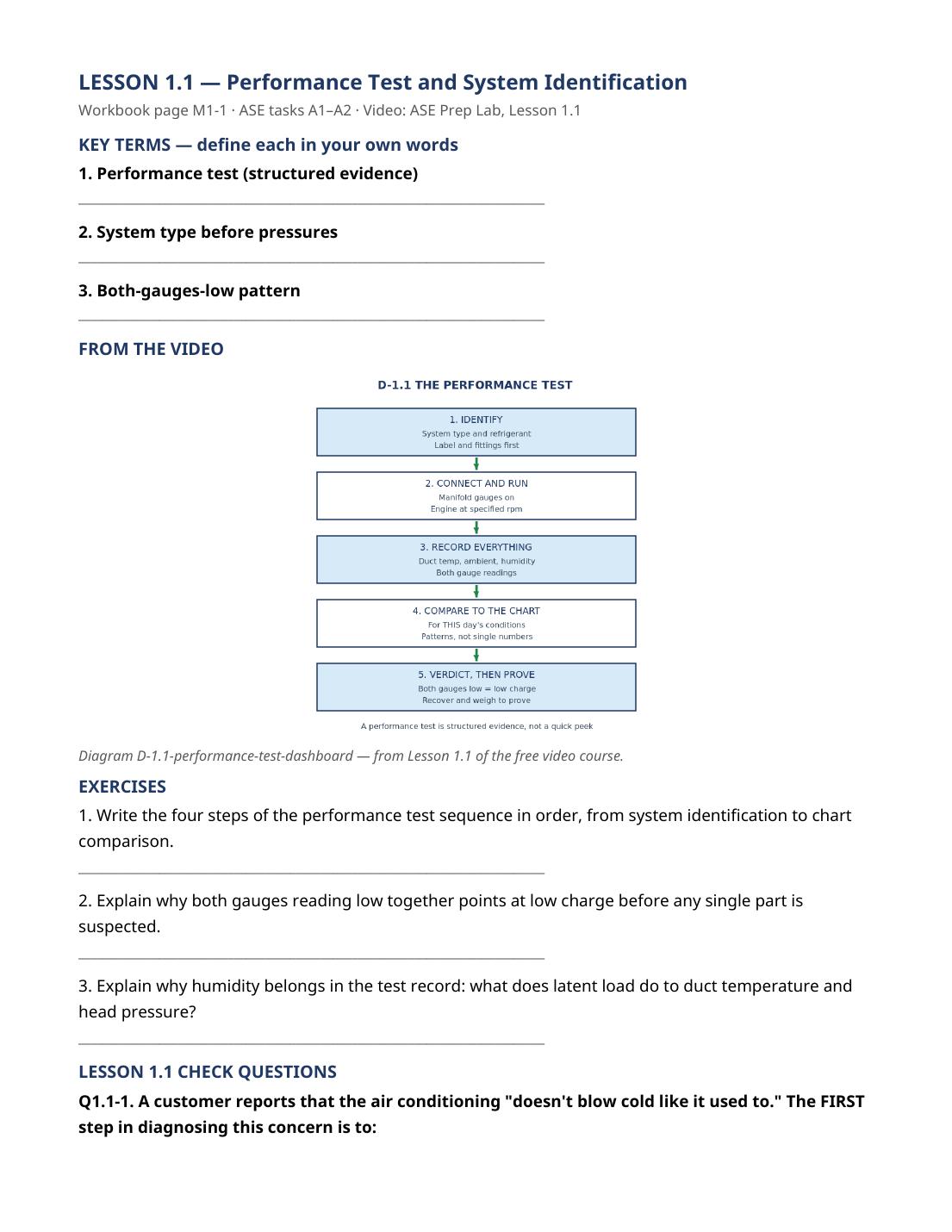
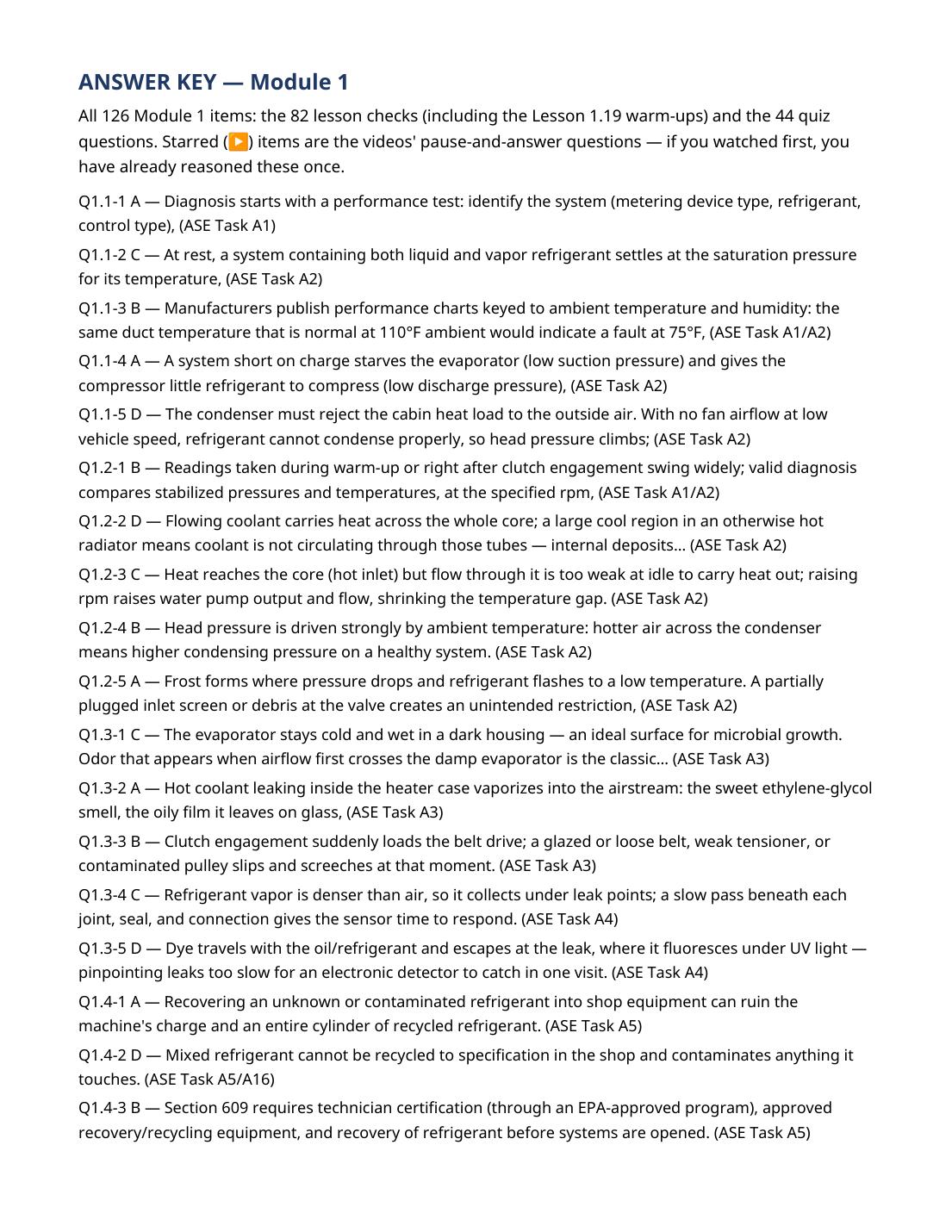
Actual pages from the ASE A7 Heating & Air Conditioning Module 1 workbook — the same PDF you download after checkout. Every module follows this format: a follow-along worksheet for each lesson, lesson check questions, a timed module quiz, and a complete answer key with rationales.
Timed module quiz — Module 1 workbook, PDF page 40Follow-along worksheet — Lesson 1.1, Module 1 workbook, PDF page 2Answer key with rationales — Module 1 workbook, PDF page 49
Printable workbooks
Prefer to study on paper? Each module has a printable follow-along workbook with worksheets and practice questions
drawn from the same 300-question bank as the video course.
Buying one topic at a time? Each module below includes only that module\'s workbook and its questions. The complete pack above includes every module plus the Finals mock exams.
Seven questions from the ASE A7 question bank, spread across the modules. Pick your answer, then open the reveal
to check it and read the explanation.
Sample question 1 (QA-22, Module 1)
A sweet smell inside the vehicle, a greasy film on the inside of the windshield, and a slowly dropping coolant level most likely indicate:
A leaking heater core
An evaporator refrigerant leak
A clogged cabin air filter
Mildew on the evaporator
Show answer
Answer: A. Hot coolant leaking inside the heater case vaporizes into the airstream: the sweet ethylene-glycol smell, the oily film it leaves on glass, and the coolant loss form one signature. Distractors: B does not consume engine coolant or film the windshield. C reduces airflow but causes neither symptom. D explains odor only — not coolant loss or the greasy film. Source: Task A3.
Sample question 2 (QA-64, Module 1)
An orifice tube pulled from a poorly cooling system is coated with gray metallic paste and dark debris. This finding indicates:
Compressor internal wear contaminating the whole system
A plugged cabin filter
Normal orifice tube appearance
An overcharge of oil only
Show answer
Answer: A. The orifice tube screen is the system's debris trap, and metallic paste there is the compressor's wear material on display. The repair is a system cleanup and compressor replacement, not just a new tube — a fresh tube alone will plug again. Distractors: B affects cabin airflow only. C — a healthy tube shows at most minor lint-like debris, not metallic paste. D does not create metal particles. Source: Task A7.
Sample question 3 (QA-106, Module 1)
To verify a thermostat's operation on the vehicle, the technician can:
Feel the thermostat housing with a bare hand at full temperature
Observe warm-up behavior: coolant temperature (scan data or gauge) and the upper radiator hose staying cool until the rated opening temperature, then warming quickly as the thermostat opens
Remove the radiator cap on a hot engine
Judge by heater output alone after one minute
Show answer
Answer: B. A working thermostat holds the radiator out of the circuit during warm-up, then opens at its rating — the hose temperature step and the scan-temperature curve show both events. (A bench test in heated water against the stamped rating confirms a removed unit.) Distractors: A is a burn risk and a guess. C is a serious safety violation. D judges before the system has even warmed. Source: Task A25.
Sample question 4 (QB-15, Module 2)
A "clutchless" variable-displacement compressor can be identified because:
It has no electromagnetic clutch — the pulley is coupled to the shaft at all times and displacement is varied internally instead of cycling a clutch
It has no pulley
It never pumps refrigerant
It is only used on hybrid vehicles
Show answer
Answer: A. Clutchless compressors run whenever the engine runs; capacity is controlled by changing piston stroke via a control valve (mechanical or PCM-driven solenoid). Diagnosis shifts from clutch circuits to displacement control. Distractors: B — the pulley is present and always coupled. C — it pumps continuously, at variable stroke. D — clutchless designs are common on conventional vehicles too. Source: Task B4.
Sample question 5 (QB-45, Module 2)
An orifice tube meters refrigerant by:
Providing a fixed, calibrated restriction at the evaporator inlet; flow varies only with the pressure difference across it
Sensing superheat and modulating
Responding to a sensing bulb
Opening and closing electrically
Show answer
Answer: A. The orifice tube is a fixed hole (its diameter is size/color coded). It cannot adapt to load, which is why orifice systems pair it with a cycling clutch or variable compressor and an accumulator — system-level answers to a deliberately simple part. Distractors: B and C describe the TXV. D describes an electronic valve. Source: Task B13.
Sample question 6 (QC-29, Module 3)
The clutch fuse blows the instant the A/C is commanded, and the clutch coil tests within resistance specification. Testing shows the clutch diode has failed shorted. This explains the fuse failure because:
The diode is in the evaporator
A shorted diode places a near-direct short across the coil's feed each time power is applied
Diodes normally consume the fuse's full rating
The coil must also be shorted
Show answer
Answer: B. The diode sits across the coil in parallel; shorted, it becomes the lowest-resistance path in the circuit and the fuse sacrifices itself at switch-on. Component-level testing (diode out of circuit) separates it from the good coil. Distractors: A misplaces the part. C misstates diode operation. D is contradicted by the coil's in-spec measurement. Source: Task C3.
Sample question 7 (QC-86, Module 3)
A customer reports the blower sometimes runs for a minute or two AFTER the vehicle is shut off and parked. No faults are found. This is most likely:
A stuck relay in all cases
A parasitic drain complaint
The evaporator afterblow feature, which runs the blower after shutdown to dry the evaporator and prevent musty odors
A failed control head
Show answer
Answer: C. Afterblow is a deliberate anti-odor strategy on many vehicles: a timed blower run dries the core after A/C use. It is documented behavior, distinguishable from a stuck relay by its consistency (only after A/C use, timed, then stops). Distractors: A would run until the battery died, A/C history or not. B mislabels a designed function. D is unnecessary where behavior matches the feature description. Source: Task C15.
All 300 questions for ASE A7 — with full answer keys — are in the printable workbooks above, and every one is
worked through in the free video lessons.
 ASE Prep Lab