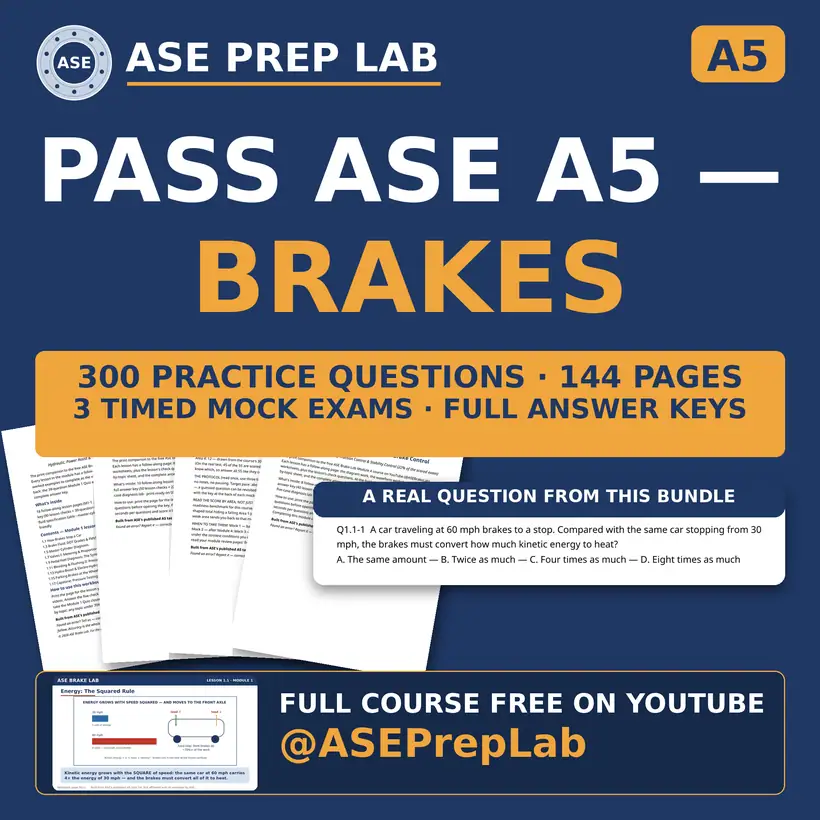
Practice away from the video: work through the questions, check the explanations, and use the printable mock exams to guide your review. The complete A5 pack includes every module workbook and the Finals pack. The mock exams draw from the same 300-question bank. The ASE A5 exam itself is 55 questions (45 scored + 10 unscored) in 75 minutes.
300practice questions with full answer keys in every course workbook
Task-list based — built from ASE's published task list
Hydraulics, drum and disc brakes, and ABS/ESC — the complete A5, lesson by lesson.
What's in the complete A5 pack
Every A5 module workbook — follow-along worksheets matched to the free video lessons
The complete 300-question bank with full answer explanations
Three printable mock exams with full answer keys
One-time purchase · Digital files for personal study
Look inside the workbook
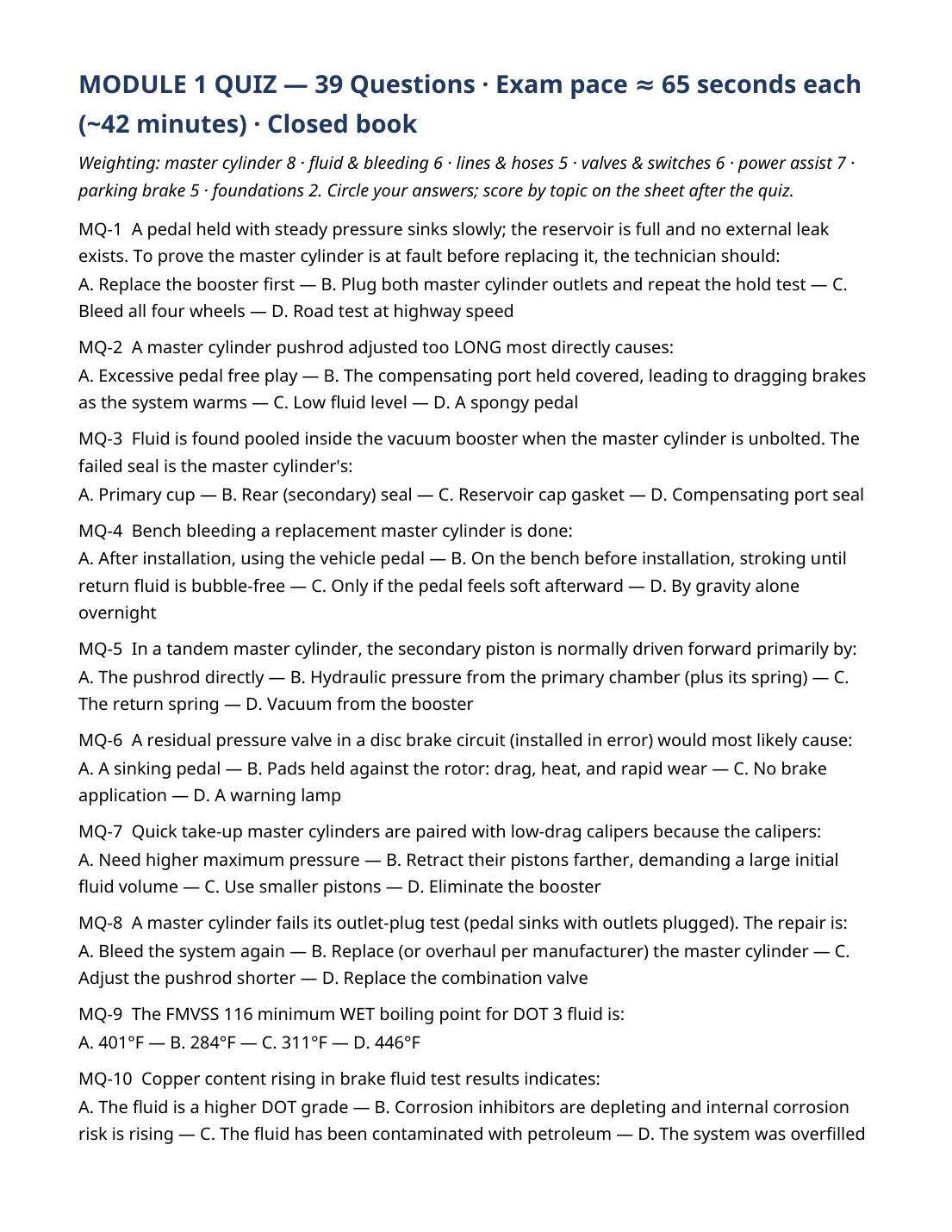
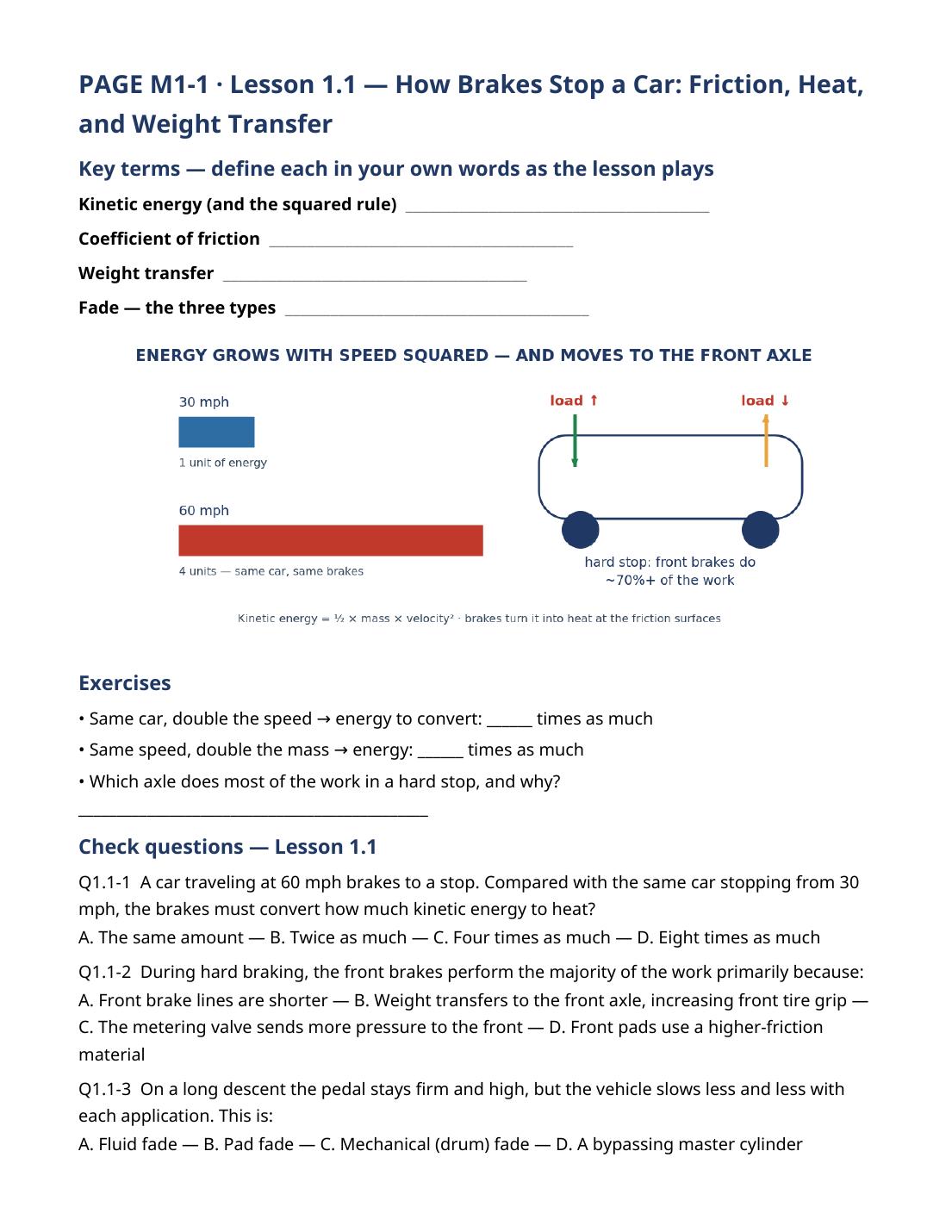
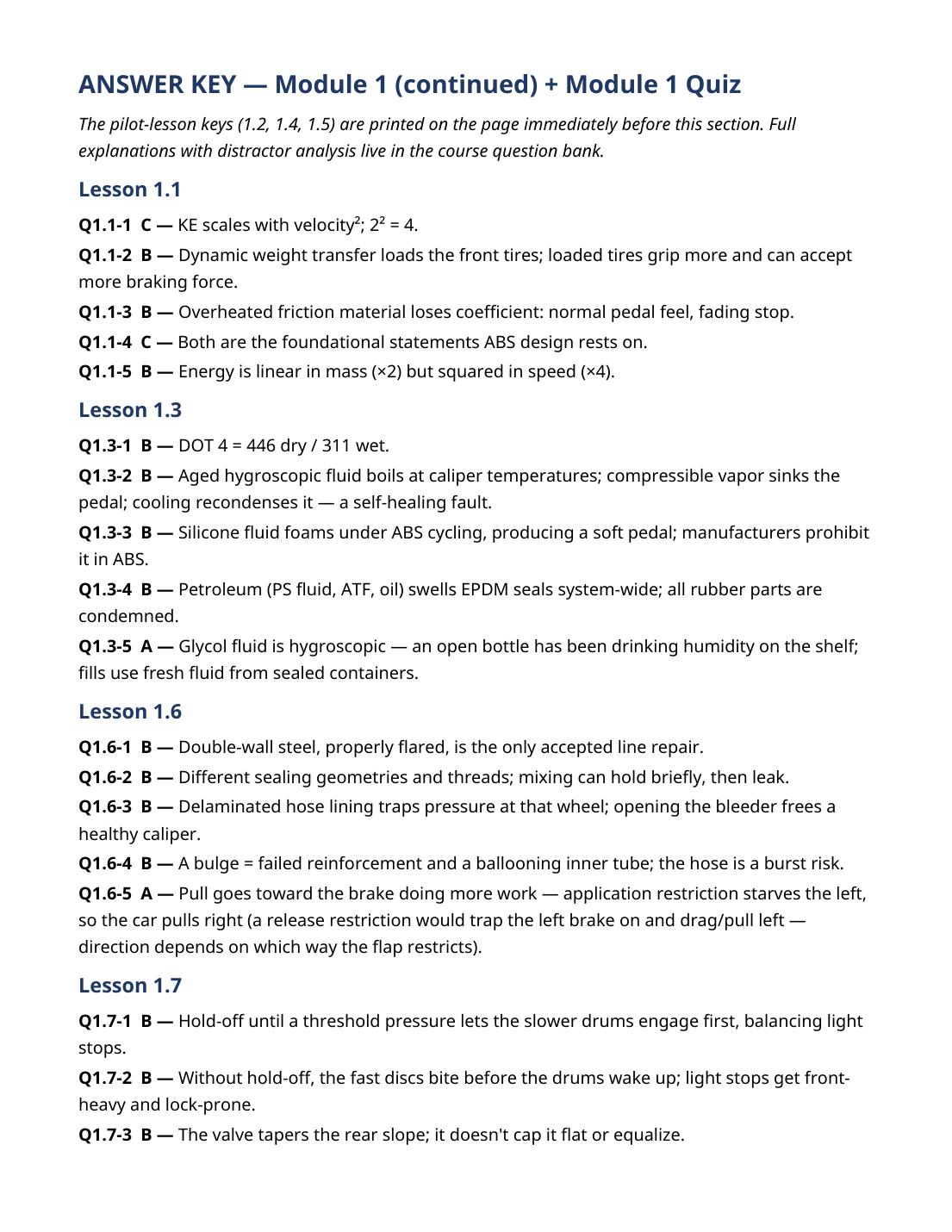
Actual pages from the ASE A5 Brakes Module 1 workbook — the same PDF you download after checkout. Every module follows this format: a follow-along worksheet for each lesson, lesson check questions, a timed module quiz, and a complete answer key with rationales.
Timed module quiz — Module 1 workbook, PDF page 38Follow-along worksheet — Lesson 1.1, Module 1 workbook, PDF page 2Answer key with rationales — Module 1 workbook, PDF page 44
Printable workbooks
Prefer to study on paper? Each module has a printable follow-along workbook with worksheets and practice questions
drawn from the same 300-question bank as the video course.
Buying one topic at a time? Each module below includes only that module\'s workbook and its questions. The complete pack above includes every module plus the Finals mock exams.
Seven questions from the ASE A5 question bank, spread across the modules. Pick your answer, then open the reveal
to check it and read the explanation.
Sample question 1 (Q1.7-4, Module 1)
An unloaded pickup's rear wheels lock before the fronts during hard braking. The proportioning valve is a height-sensing type. Which of these could be the cause?
The sensing linkage is seized at the loaded (high) position
The metering valve is stuck closed
The master cylinder compensating port is blocked
The front pads are worn out
Show answer
Answer: A. Frozen at the loaded setting, the valve passes high rear pressure the empty bed's tires can't use. Distractors: B affects front timing on light stops; C self-applies all brakes with heat; D doesn't raise rear pressure. Source: Task A13.
Sample question 2 (Q1.15-2, Module 1)
On a caliper-integrated parking brake, the cable lever applies the brake by:
Squeezing the caliper bracket
Driving an internal cam/screw mechanism that mechanically advances the piston
Pulling the pads together with a cross-spring
Locking the rotor with a pin
Show answer
Answer: B. The mechanism screws the piston out to clamp — which is also why these pistons rotate back for service. Distractors: A/C/D describe hardware that doesn't exist in this design. Source: Tasks A25/A29.
Sample question 3 (Q2.2-3, Module 2)
A drum's friction surface shows bluish, raised, heat-checked islands that a fingernail catches on. These are:
Normal machining marks
Hard (heat) spots — the drum's heat damage, generally a replace decision
Rust scale that will wear off
Glazing that sandpaper cures
Show answer
Answer: B. Hard spots are metallurgical damage; lathe bits skate over them and they return. Distractors: A — machining marks are uniform grooves. C/D dress up damage as cosmetics. Source: Task B3.
Sample question 4 (Q2.5-3, Module 2)
A rear wheel bearing growl changes noticeably when the vehicle swerves gently left versus right at speed. This load sensitivity most strongly suggests:
Tire noise
A failing wheel bearing on the corner that gets louder when loaded
An out-of-round drum
A dragging shoe
Show answer
Answer: B. Bearing noise follows load transfer (task B11); it quiets on the unloaded side and growls on the loaded side. Distractors: A — tire noise is comparatively load-stable. C/D produce pulsation/drag symptoms, not speed growl modulated by swerving. Source: Task B11.
Sample question 5 (Q3.3-4, Module 3)
A rotor's thickness measures 0.001 in BELOW its stamped minimum thickness, with a perfect surface. The rotor should be:
Machined lightly
Installed with new pads
Replaced — a rotor at/below minimum is done regardless of surface
Measured again after cooling
Show answer
Answer: C. Below-minimum is a verdict, not a condition grade. Distractors: A removes more metal from a condemned part. B/D stall the inevitable. Source: Task C8.
Sample question 6 (Q3.8-3, Module 3)
Before the road test after disc service, the static checks include all EXCEPT:
Pedal pumped firm and held under pressure while corners are inspected
Reservoir level verified
A full-throttle acceleration run
Parking brake hold-and-release
Show answer
Answer: C. Static means in the bay; the road test has its own phases. Distractors: A/B/D are the checklist. Source: Tasks C12/C13.
Sample question 7 (Q4.5-1, Module 4)
At key-on, both brake warning lamps illuminate for a few seconds. This is:
A fault
The bulb check / prove-out — a lamp that does NOT light here is itself diagnostic data
A bulb test only the dealer can interpret
Low voltage
Show answer
Answer: B. Prove-out verifies the telltales themselves. Distractors: A inverts it. C/D deflect. Source: Task D3.
All 300 questions for ASE A5 — with full answer keys — are in the printable workbooks above, and every one is
worked through in the free video lessons.
 ASE Prep Lab