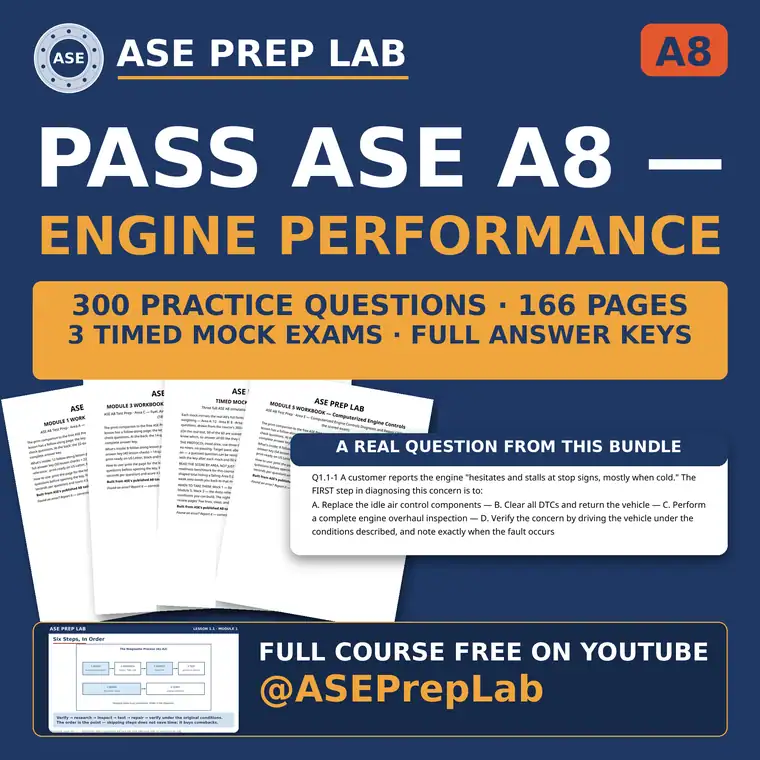
The complete ASE A8 course, free on YouTube: 42 video lessons built from ASE's published
A8 task list, with a printable workbook for every module. The ASE A8 exam itself is 60 questions (50 scored + 10 unscored) in 75 minutes.
Every A8 module workbook — follow-along worksheets matched to the free video lessons
The complete 300-question bank with full answer explanations
Three printable mock exams with full answer keys
One-time purchase · Digital files for personal study
Look inside the workbook
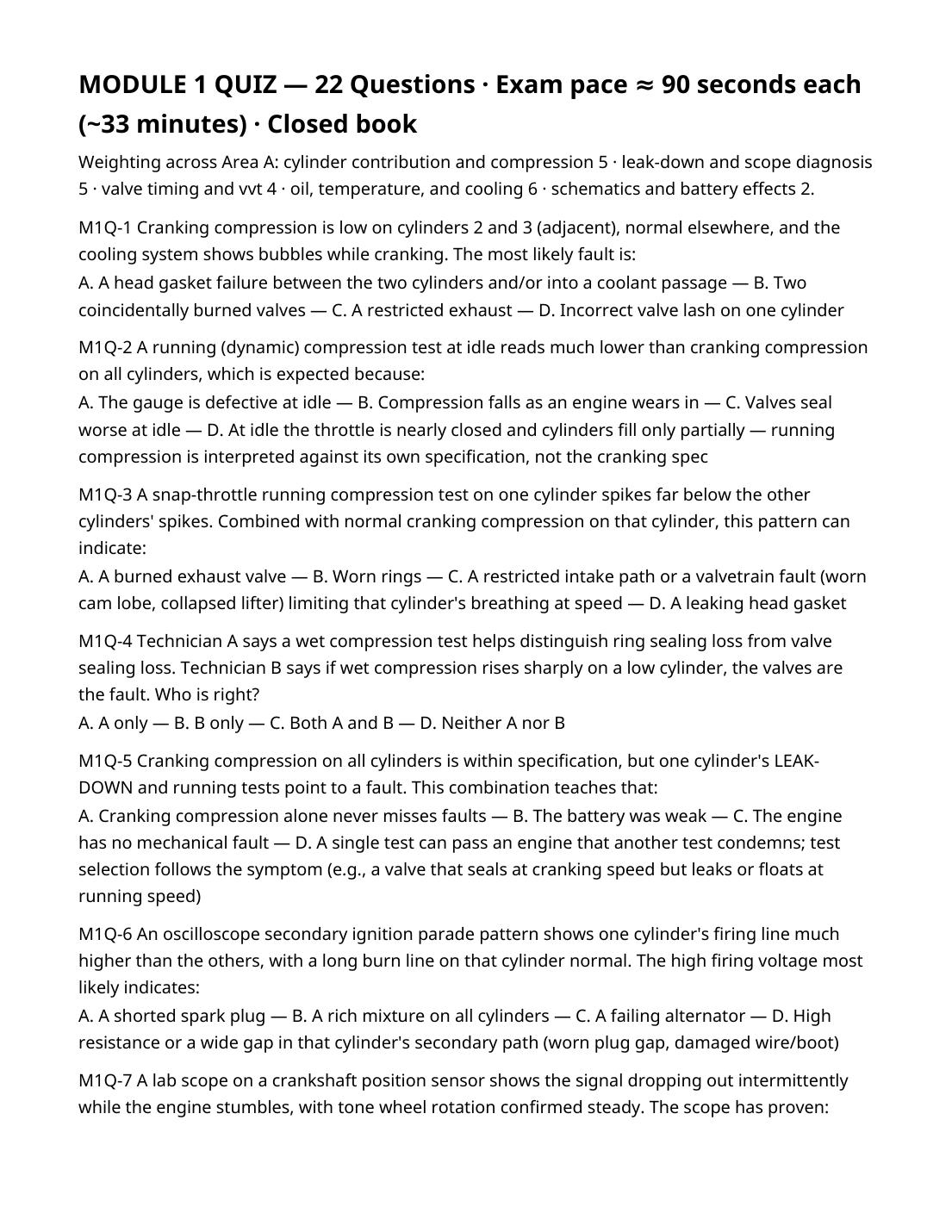
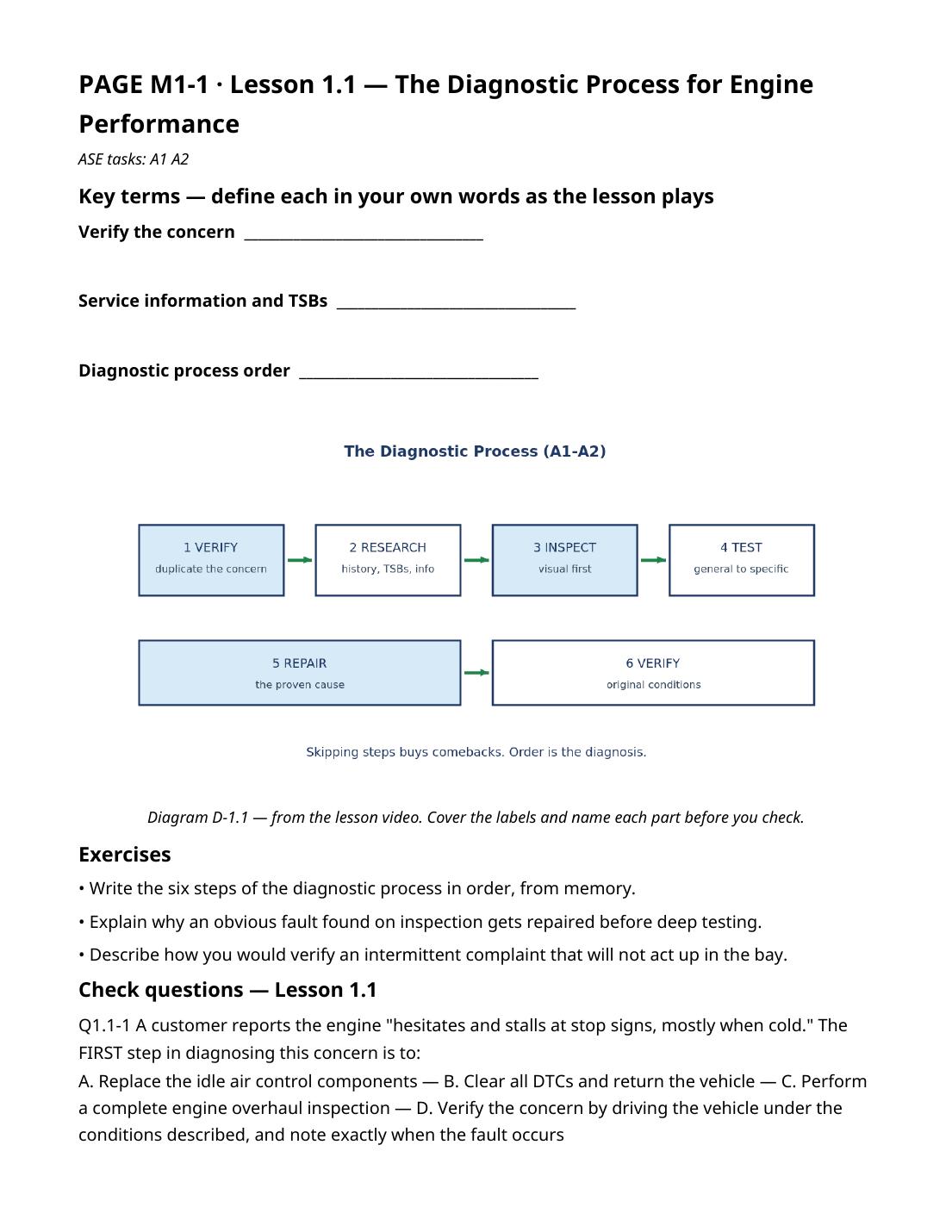
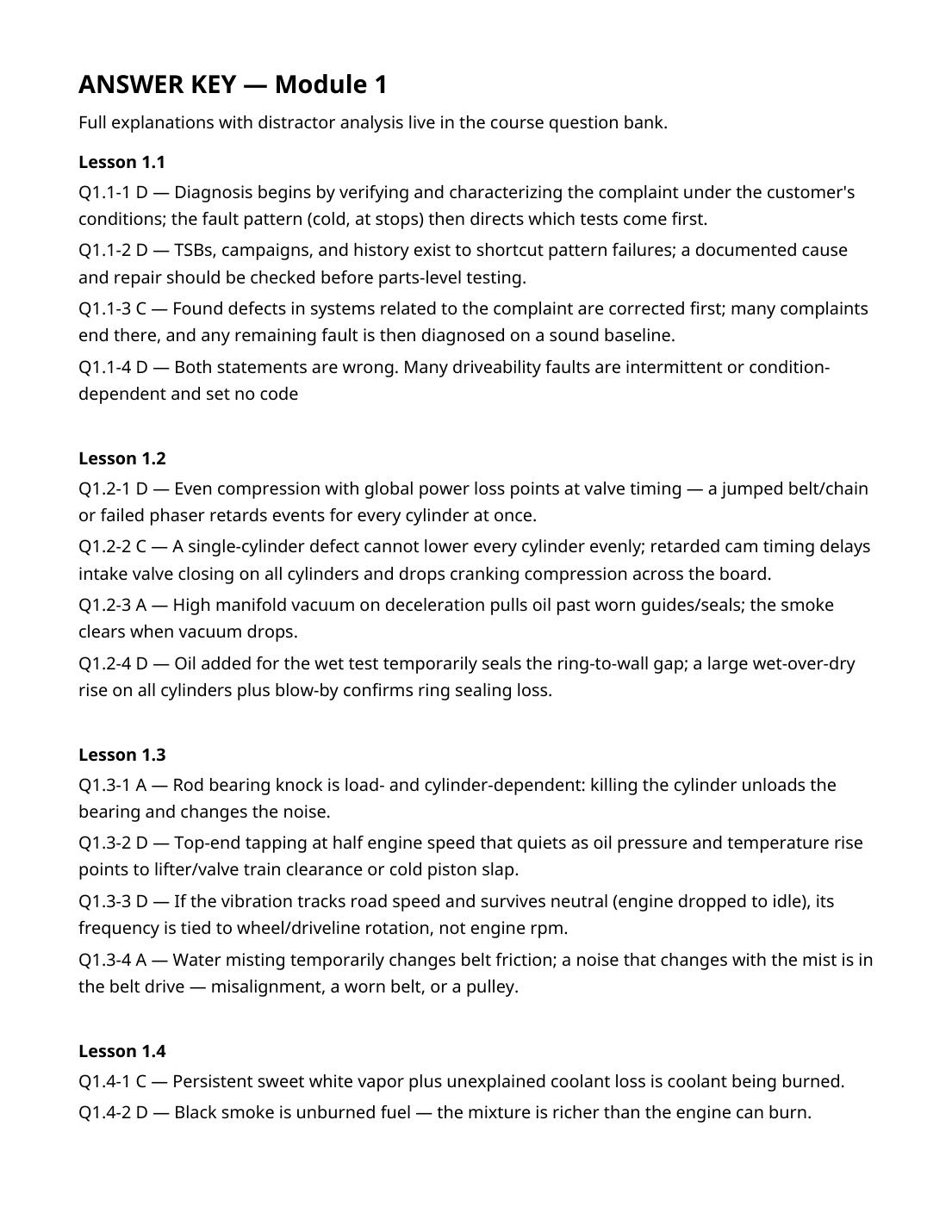
Actual pages from the ASE A8 Engine Performance Module 1 workbook — the same PDF you download after checkout. Every module follows this format: a follow-along worksheet for each lesson, lesson check questions, a timed module quiz, and a complete answer key with rationales.
Timed module quiz — Module 1 workbook, PDF page 25Follow-along worksheet — Lesson 1.1, Module 1 workbook, PDF page 2Answer key with rationales — Module 1 workbook, PDF page 29
Printable workbooks
Prefer to study on paper? Each module has a printable follow-along workbook with worksheets and practice questions
drawn from the same 300-question bank as the video course.
Buying one topic at a time? Each module below includes only that module\'s workbook and its questions. The complete pack above includes every module plus the Finals mock exams.
Seven questions from the ASE A8 question bank, spread across the modules. Pick your answer, then open the reveal
to check it and read the explanation.
Sample question 1 (QA-19, Module 1)
A hissing/whistling sound from the exhaust area with a noticeable power loss at higher rpm suggests:
Exhaust restriction (collapsed muffler baffle or damaged converter substrate)
A vacuum leak
A worn water pump bearing
An ignition misfire
Show answer
Answer: A. A restricted exhaust chokes flow — the engine falls flat as rpm and exhaust volume rise, often with audible backpressure hiss. Distractors: B affects idle quality most. C is a front-of-engine noise. D causes popping/shake, not flow hiss. Source: Tasks A5/C13.
Sample question 2 (QA-24, Module 1)
A vacuum needle that floats slowly up and down over a range of several inHg at idle most commonly indicates:
A perfectly sealed engine
A burned valve
A restricted catalytic converter
An air/fuel mixture problem (lean or rich) or a small, general vacuum leak
Show answer
Answer: D. A slow, wandering float is the classic mixture/general-leak signature — the engine hunts as the mixture drifts. Distractors: A reads high and steady. B drops rhythmically for one cylinder. C falls with rpm under sustained speed. Source: Task A6.
Sample question 3 (QB-13, Module 2)
DTC P0300 (random/multiple cylinder misfire) with no single-cylinder code most often directs diagnosis toward:
Causes shared by multiple cylinders: fuel pressure/volume, air measurement, EGR faults, vacuum leaks, or ignition supply — rather than one cylinder's parts
One spark plug
One coil
One injector
Show answer
Answer: A. A random misfire code is by definition not localized; the diagnostic path starts with systems common to all cylinders. Distractors: B, C, and D are single-cylinder parts that would typically set a cylinder-specific P030x code. Source: Task B2.
Sample question 4 (QB-37, Module 2)
Before replacing a coil that shows no output, the technician must verify:
Primary power, ground, and trigger signal at the coil — a coil cannot be condemned until its inputs are proven
The spark plug gap on the affected cylinder
Fuel pressure at the rail
The crankshaft position sensor's signal
Show answer
Answer: A. No output with missing input is a circuit fault wearing a coil's clothes; inputs first is the standing rule for every component. Distractors: B, C, and D are real checks on the same complaint, but none of them condemns the coil — only its power, ground, and trigger can do that. Source: Task B5.
Sample question 5 (QC-22, Module 3)
A fuel pump that runs continuously with the key on and engine off (no prime timeout) suggests:
Normal operation on all vehicles
A stuck/welded pump relay contact, a short to power in the control circuit, or a failed pump driver — a safety and pump-life fault to correct
A restricted filter
A leaking injector
Show answer
Answer: B. Prime is a timed event; continuous key-on running means the control side is stuck on. Distractors: A — a brief prime is normal, continuous running is not. C and D are hydraulic faults that cannot power the pump. Source: Tasks C4/C5.
Sample question 6 (QD-25, Module 4)
Technician A says a converter can be damaged by an engine misfire that sends unburned fuel into the exhaust. Technician B says leaded fuel or certain sealant/contamination exposures can poison a converter's washcoat without melting it. Who is right?
A only
B only
Both A and B
Neither A nor B
Show answer
Answer: C. Both failure families are real: thermal destruction from burning fuel, and chemical poisoning that kills oxygen storage while the brick looks intact. Distractors: A-only and B-only each omit a genuine mechanism. Neither denies documented converter failure modes. Source: Task D9 (AIR/CAT).
Sample question 7 (Module 5 workbook, Q5.1-5)
Two codes are stored: a MAF circuit range/performance code and a lean code. The diagnostic priority is generally to:
Diagnose the lean code first
Diagnose the circuit/input code first, because a bad air measurement can be the cause of the lean condition downstream
Replace both sensors
Clear both and wait a week
Show answer
Answer: B. Input faults create output faults; fixing the cause often clears the effect, while chasing the effect first wastes the evidence. Source: ASE A8 Area E — Computerized Engine Controls.
All 300 questions for ASE A8 — with full answer keys — are in the printable workbooks above, and every one is
worked through in the free video lessons.
 ASE Prep Lab