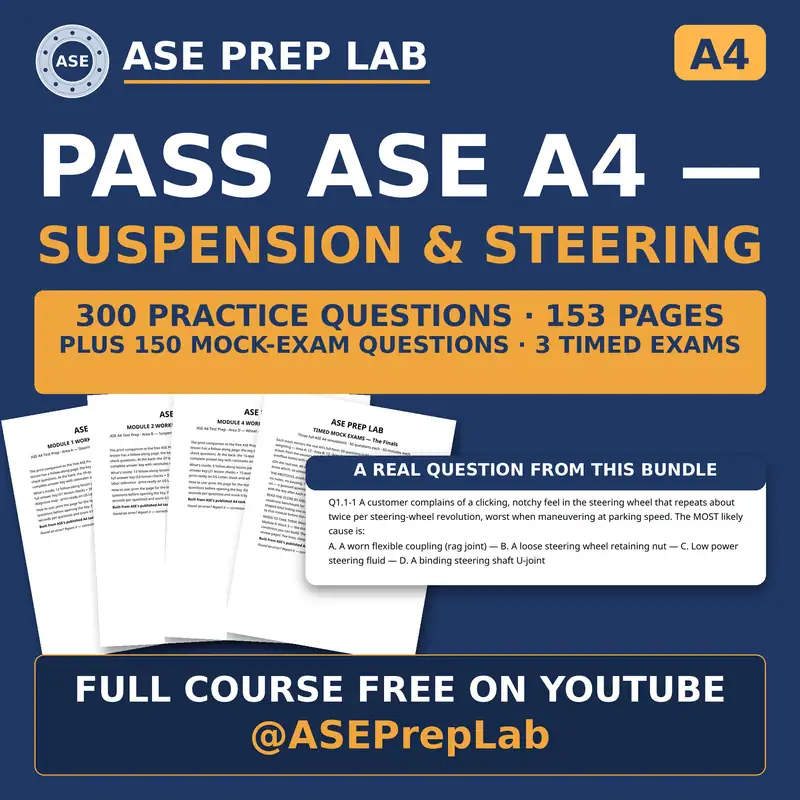
The complete ASE A4 course, free on YouTube: 39 video lessons built from ASE's published
A4 task list, with a printable workbook for every module. The ASE A4 exam itself is 50 questions (40 scored + 10 unscored) in 60 minutes.
Every A4 module workbook — follow-along worksheets matched to the free video lessons
The complete 300-question bank with full answer explanations
Three printable mock exams with full answer keys
One-time purchase · Digital files for personal study
Look inside the workbook
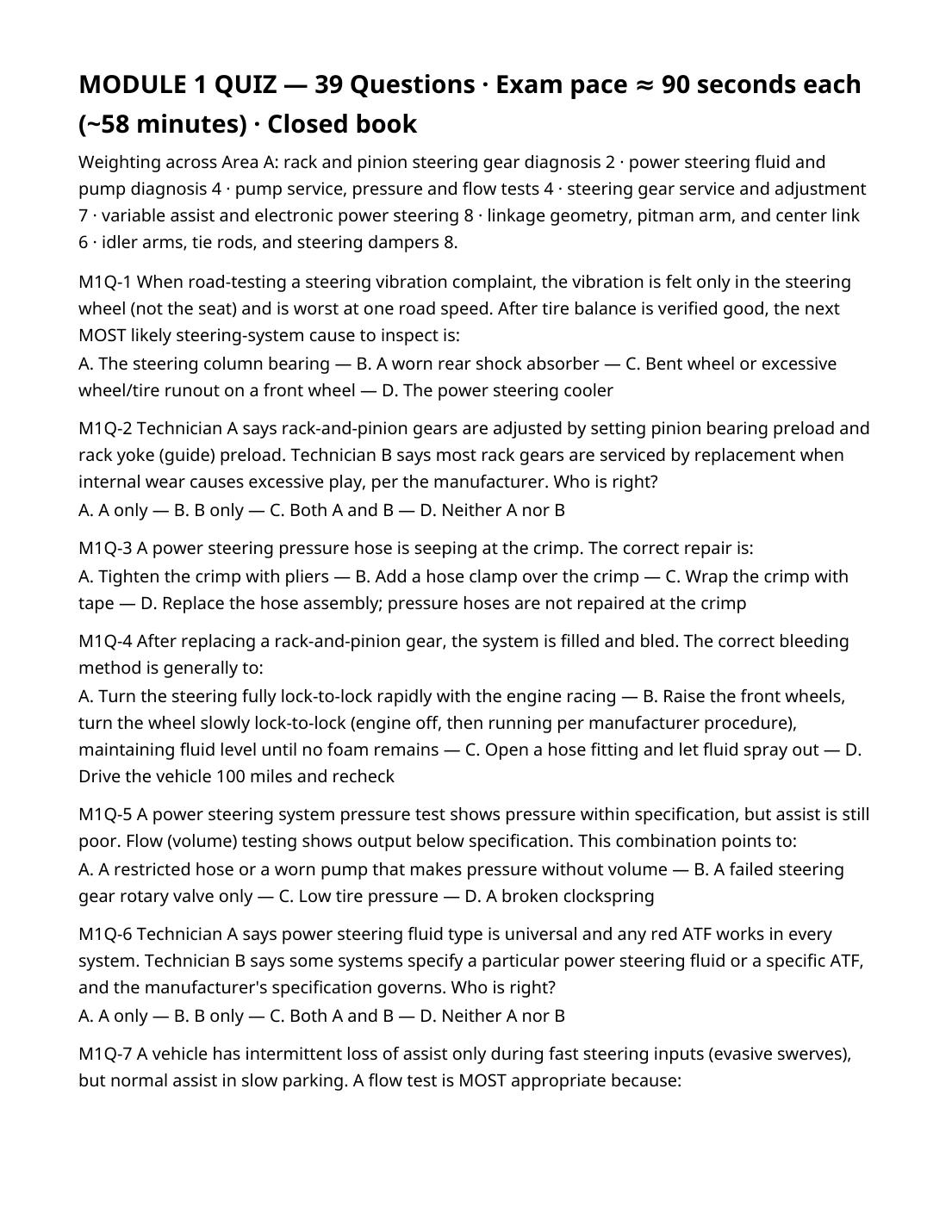
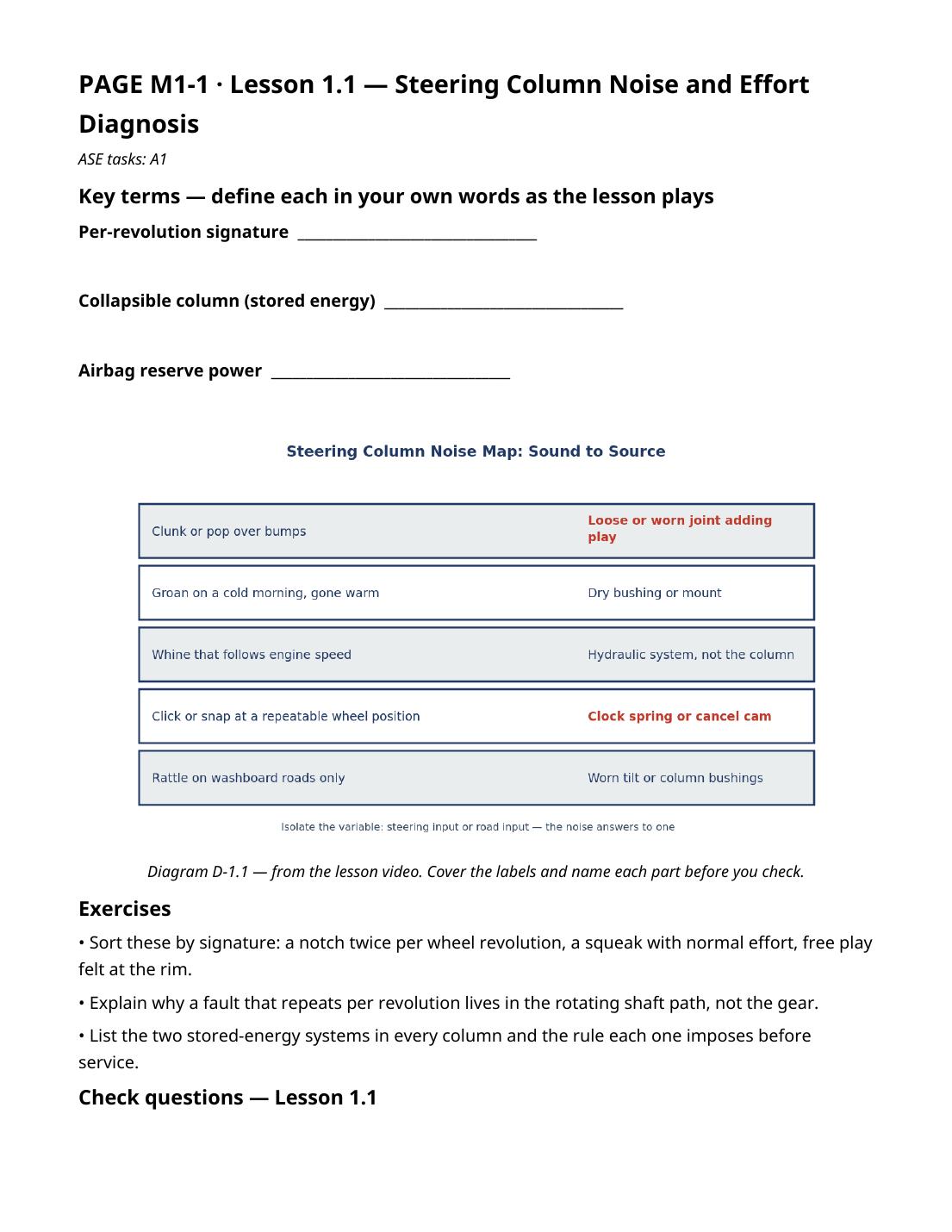
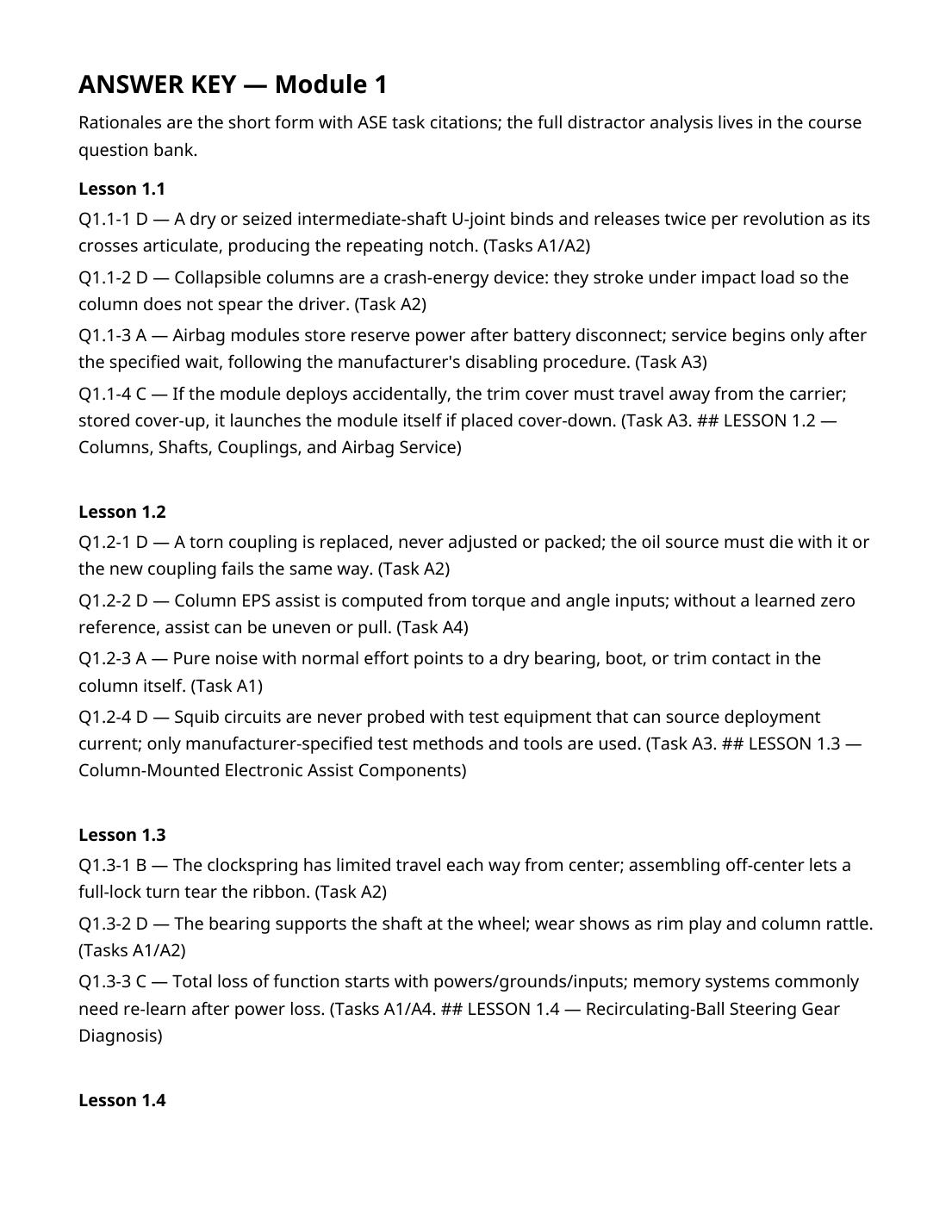
Actual pages from the ASE A4 Suspension & Steering Module 1 workbook — the same PDF you download after checkout. Every module follows this format: a follow-along worksheet for each lesson, lesson check questions, a timed module quiz, and a complete answer key with rationales.
Timed module quiz — Module 1 workbook, PDF page 25Follow-along worksheet — Lesson 1.1, Module 1 workbook, PDF page 2Answer key with rationales — Module 1 workbook, PDF page 31
Printable workbooks
Prefer to study on paper? Each module has a printable follow-along workbook with worksheets and practice questions
drawn from the same 300-question bank as the video course.
Buying one topic at a time? Each module below includes only that module\'s workbook and its questions. The complete pack above includes every module plus the Finals mock exams.
Seven questions from the ASE A4 question bank, spread across the modules. Pick your answer, then open the reveal
to check it and read the explanation.
Sample question 1 (QA-23, Module 1)
All of the following can cause a power steering pull (lead) EXCEPT:
A mis-centered steering gear rotary valve
Unequal front tire pressures
A radial tire pull
Excessive steering gear sector lash
Show answer
Answer: D. Sector lash is freeplay at center; it produces wander and play, not a steady one-direction pull. Distractors: A biases assist to one side. B makes the vehicle lead toward the low tire. C — a belt-shifted tire pulls regardless of the steering system. Source: Tasks A5/A15.
Sample question 2 (QA-67, Module 1)
A steering angle sensor lives on the column and was disturbed during column service. After reassembly the wheel is centered but the sensor reads 15° at straight-ahead. Required action:
Nothing; the module will average it out
Replace the tires
Rotate the steering wheel one spline
Recalibrate/relearn the sensor zero per the manufacturer's procedure and verify with the scan tool
Show answer
Answer: D. The sensor's electrical zero must be taught; a 15° offset feeds false data to EPS and stability control. Distractors: A — modules do not self-average a hard offset. C moves the mechanical center off the gear's center instead of fixing the reference. B is unrelated. Source: Tasks A4/A20/C16.
Sample question 3 (QB-23, Module 2)
When pressing a ball joint out of a control arm, the press force must be applied:
To the arm's bushing
Squarely to the joint housing with the arm fully supported so the arm's bore is not distorted
With an impact hammer on the stud
Only with heat
Show answer
Answer: B. The bore in the arm is the press fit's home; unsupported or crooked pressing eggs the bore and the new joint will not stay seated. Distractors: A loads the wrong component. C damages threads and the arm. D ruins temper and bushings. Source: Task B5.
Sample question 4 (QB-68, Module 2)
Interleaf friction in a leaf spring pack is managed by:
Greasing between the leaves in service
Interleaf liners/insulators and tip pads fitted by design; dry, rusty leaves raise friction, harshness, and squeak
Removing leaves
Painting the pack monthly
Show answer
Answer: B. Liners and pads are the designed friction control; corroded packs get noisy and harsh as leaves drag. Distractors: A is not a service practice for modern packs. C changes spring rate. D is cosmetic fantasy. Source: Task B19.
Sample question 5 (QC-26, Module 3)
On a vehicle with no factory caster adjustment, caster out of specification indicates:
A normal condition
That caster need not be measured
A tire fault
Bent, shifted, or worn parts (control arm, strut rod bushings, subframe position, or collision damage) that must be found and repaired
Show answer
Answer: D. A non-adjustable angle out of spec is a damage report, not an adjustment task. Distractors: A/B dismiss a structural finding. C — tires do not change measured caster. Source: Tasks C5/C6/C17.
Sample question 6 (QC-66, Module 3)
A vehicle is being aligned after front strut replacement. The alignment sequence that protects the result is:
Set toe first, then camber
Set the rear last
Set caster/camber first, then toe last, because toe is disturbed by every other adjustment and by its own tie rod work
Random order
Show answer
Answer: C. Toe is always the final front adjustment; anything done after it un-does it. Distractors: A inverts the protected order. B — the rear is the foundation and goes first on a four-wheel job. D is not a sequence. Source: Tasks C4/C6/C7.
Sample question 7 (QD-19, Module 4)
A vehicle has a steady pull to the right. Pressures are equal, brakes are free, alignment is in specification. Swapping the front tires side-to-side makes the vehicle pull LEFT. The diagnosis is:
Radial (conicity) tire pull — the tire itself generates the lateral force
A bent wheel
A steering gear fault
Road crown
Show answer
Answer: A. A pull that follows a tire across the car is the tire's confession: belt/conicity forces steer it regardless of position. Distractors: B — a bent wheel wobbles; it does not reverse a pull in this test. C/D stay with the car when the tires move — the pull did not. Source: Task D7.
All 300 questions for ASE A4 — with full answer keys — are in the printable workbooks above, and every one is
worked through in the free video lessons.
 ASE Prep Lab