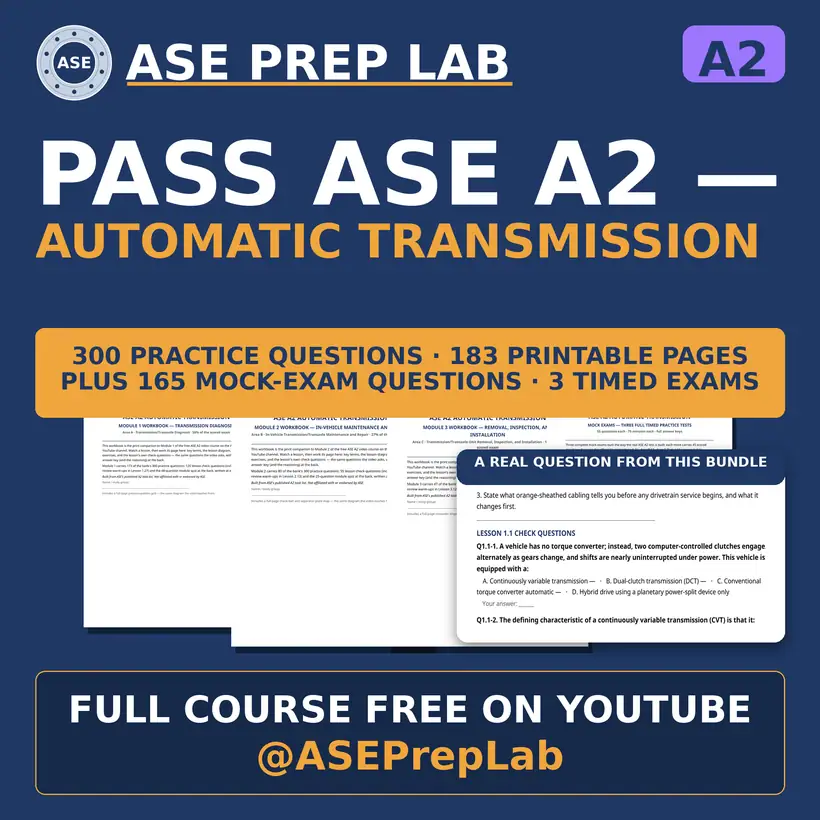
Prepare for ASE A2 Automatic Transmission/Transaxle.
The complete ASE A2 course, free on YouTube: 52 video lessons built from ASE's published
A2 task list, with a printable workbook for every module. The ASE A2 exam itself is 55 questions (45 scored + 10 unscored) in 75 minutes.
Every A2 module workbook — follow-along worksheets matched to the free video lessons
The complete 300-question bank with full answer explanations
Three printable mock exams with full answer keys
One-time purchase · Digital files for personal study
Look inside the workbook
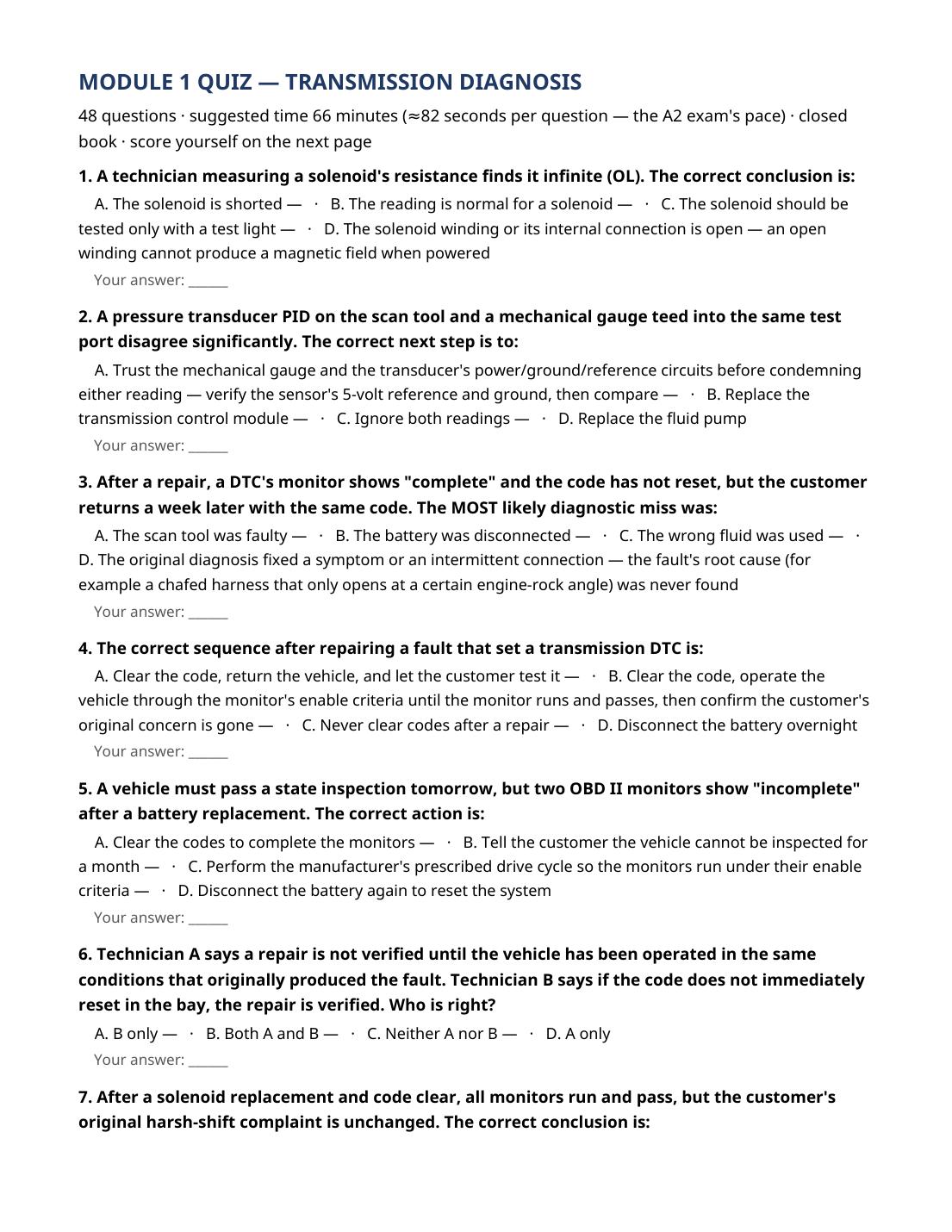
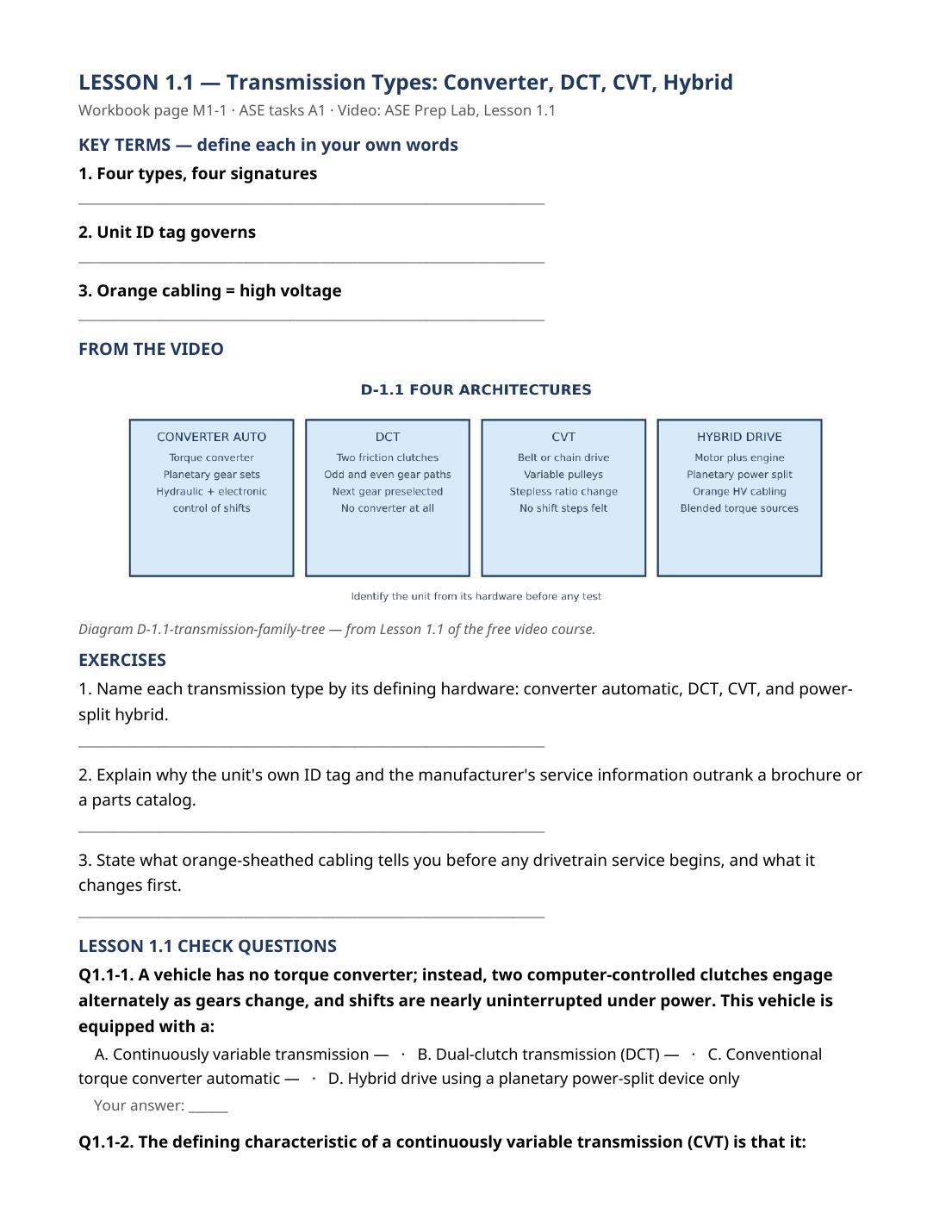
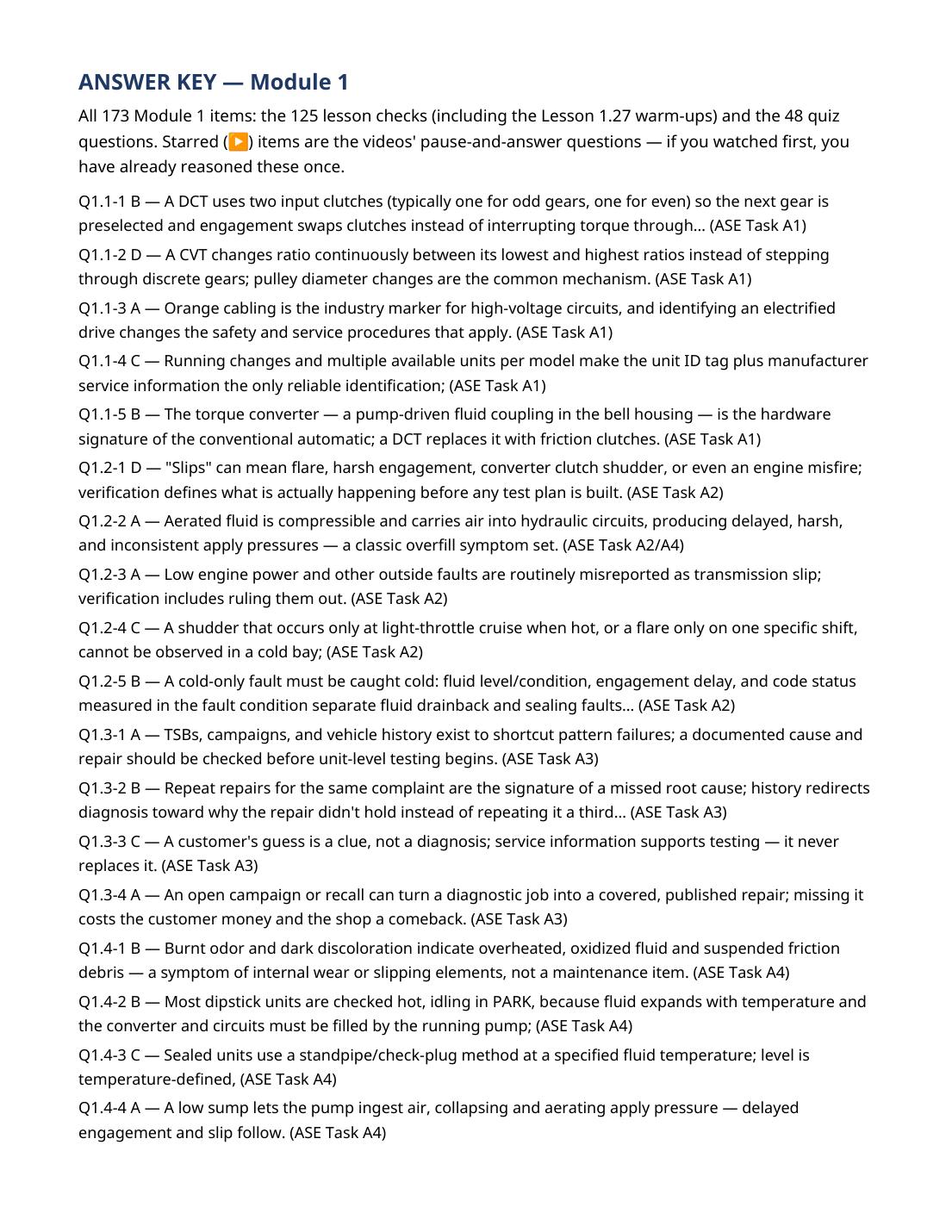
Actual pages from the ASE A2 Automatic Transmission/Transaxle Module 1 workbook — the same PDF you download after checkout. Every module follows this format: a follow-along worksheet for each lesson, lesson check questions, a timed module quiz, and a complete answer key with rationales.
Timed module quiz — Module 1 workbook, PDF page 55Follow-along worksheet — Lesson 1.1, Module 1 workbook, PDF page 2Answer key with rationales — Module 1 workbook, PDF page 65
Printable workbooks
Prefer to study on paper? Each module has a printable follow-along workbook with worksheets and practice questions
drawn from the same 300-question bank as the video course.
Buying one topic at a time? Each module below includes only that module\'s workbook and its questions. The complete pack above includes every module plus the Finals mock exams.
Seven questions from the ASE A2 question bank, spread across the modules. Pick your answer, then open the reveal
to check it and read the explanation.
Sample question 1 (QA-29, Module 1)
When a scan tool cannot communicate with the transmission control module but communicates with other modules on the same network, diagnosis should proceed to:
Replace the transmission
Condemn the scan tool
The TCM's power, ground, and network circuits — communication with other modules proves the tool and network backbone, so the fault is local to the TCM
Clear all codes and retry
Show answer
Answer: C. Eliminated branches are evidence: if the tool talks to the network but not the TCM, test what the TCM alone needs — feeds, grounds, and its network connection. Distractors: A and D act without a single circuit measurement. B is disproven by the successful communication with other modules. Source: Task A5.
Sample question 2 (QA-87, Module 1)
A shift valve is suspected of sticking. The hydraulic diagram helps the technician by showing:
The valve's part number
The bolt torque for the valve body
Which pressures act on each end of the valve (apply vs. spring/governor/solenoid side), so the technician can determine whether the valve has the signals to move or is mechanically stuck
The valve's service price
Show answer
Answer: C. A valve that never receives its apply pressure has a supply fault; a valve with correct pressures that does not move is stuck. The diagram identifies which pressures to measure before the valve is blamed. Distractors: A, B, and D are catalog/service data, not circuit logic the diagram provides. Source: Task A14.
Sample question 3 (QA-145, Module 1)
An input speed sensor (ISS) fails completely while driving. The module's typical response is:
Ratio monitoring loses its input witness, so the module sets a code and substitutes a calculated/default strategy — often a failsafe gear and maximum pressure — because it can no longer verify what the transmission is doing
Nothing changes
The engine stalls
The transmission shifts normally forever
Show answer
Answer: A. Losing the input witness blinds ratio control; modules protect the unit with defaults rather than trust it blind. Distractors: B and D ignore the sensor's role in every ratio decision. C is not a sensor-failure response. Source: Task A24.
Sample question 4 (QB-21, Module 2)
A transmission overheats after an internal failure was repaired, and the cooler was only flushed "until it ran clear." The correct cooler verification after any internal failure is:
Visual clarity of the flush fluid
The fluid temperature at idle
The cooler line color
A measured flow test against service information — debris-packed coolers can pass some fluid while restricting flow; only a flow rate proves the cooler can cool
Show answer
Answer: D. "Runs clear" is an appearance; flow is a measurement. Restricted coolers are the leading cause of repeat failure after overhaul because they also starve converter/lube circuits on many designs. Distractors: A, B, and C are impressions, not flow evidence. Source: Task B5.
Sample question 5 (QB-61, Module 2)
An accumulator piston is stuck in its bore with varnish deposits, and its shift has become harsh. Correct in-vehicle service is:
Free and clean the piston and bore, inspect for scoring, and renew the seals — a stuck accumulator is a lost cushion; bore damage beyond cleaning limits moves the repair to the valve body/case level per service information
Delete the accumulator
Install a much stronger spring
Ignore it
Show answer
Answer: A. Varnish-stuck pistons are serviceable; the judgment is bore condition, made by inspection. Distractors: B removes the cushion entirely. C recalibrates by guess. D leaves a diagnosed fault. Source: Task B8.
Sample question 6 (QC-12, Module 3)
Technician A says the torque converter must be verified fully seated, by depth measurement, before the transmission is raised into place. Technician B says after the unit is mated, the converter should spin freely by hand through the access opening before its bolts are installed — proof it is not preloaded against the pump. Who is right?
A only
B only
Both A and B
Neither A nor B
Show answer
Answer: C. The two checks bookend the mating: depth before, free rotation after. A converter that cannot spin freely is already damaging the pump. Distractors: A-only and B-only each discard a real verification. Neither rejects both. Source: Task C6.
Sample question 7 (QC-36, Module 3)
An overhauled unit's completion verification is:
A visual once-over
None — new parts verify themselves
Fill and level at temperature, pressure tests against specification, a full road test through all ranges and TCC operation, adaptation relearn, and a post-test leak inspection — the overhaul is proven as a system, not assumed
A 5-minute idle
Show answer
Answer: C. The road test is the overhaul's acceptance test, run against the original complaint and the specifications. Distractors: A, B, and D are all sub-verification states. Source: Task C17.
All 300 questions for ASE A2 — with full answer keys — are in the printable workbooks above, and every one is
worked through in the free video lessons.
ASE A2 Automatic Transmission/TransaxleComplete bundle $24.99Buy direct — $24.99
Want more free practice first? Take the ASE A2 practice test — 15 free questions with answers and explanations.
Taking the test soon? Read the ASE A2 exam guide — format, task areas, registration windows and a study plan.
 ASE Prep Lab